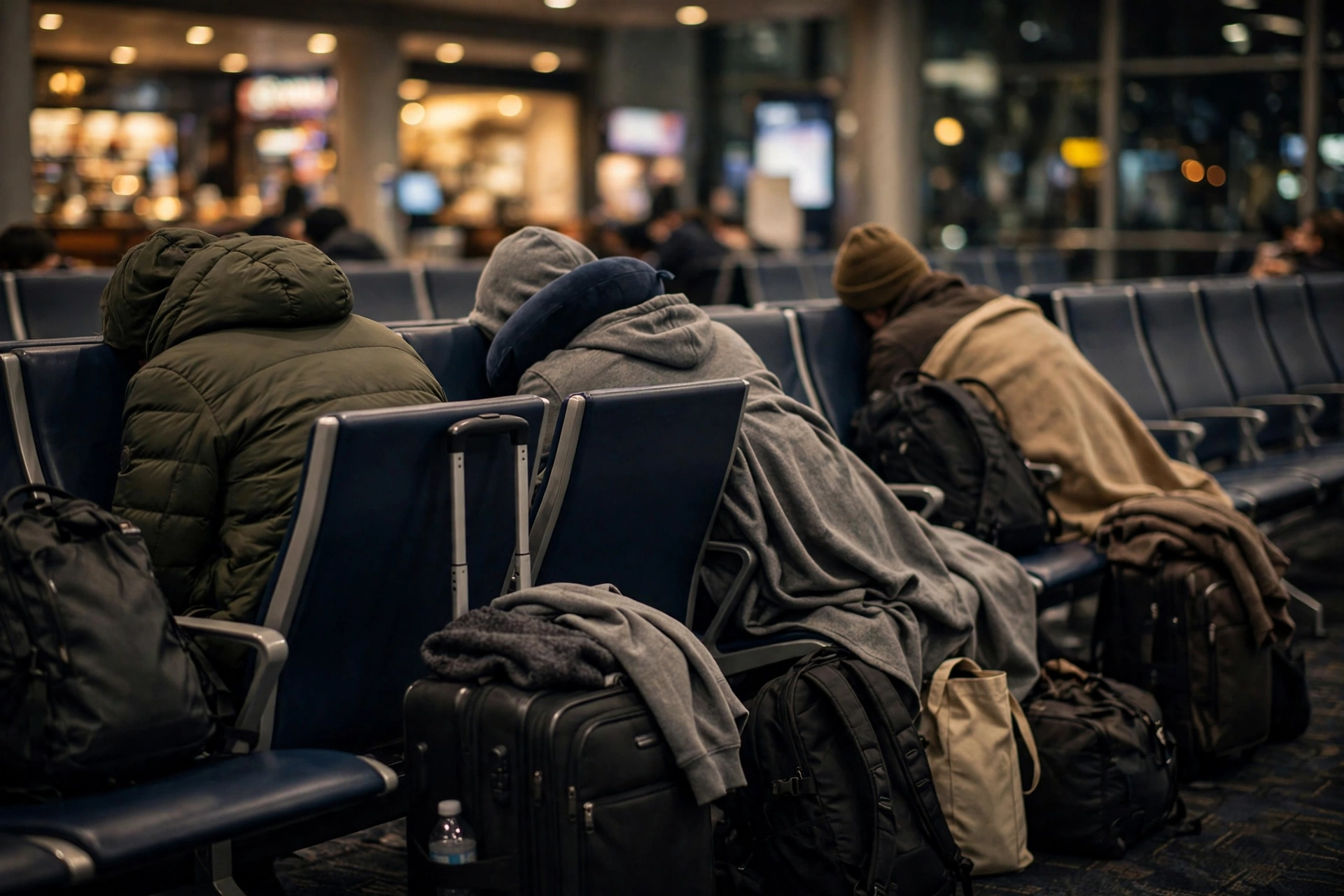
There's a particular silence that falls over a departure gate when the board changes. One minute it says 21:40. Then it says DELAYED. Then comes the update nobody wants: tomorrow, 06:15. People drift towards the desk in a slow, tired wave.
If this happens to you — and if you fly enough, it will — the next half hour matters more than the rest of the night. Seats on the first flights out disappear fast, vouchers run out, and the queue doubles while you're deciding what to do. The good news: an overnight delay has a playbook. Here it is.
Short answer
Move first, ask questions second. Get rebooked onto a confirmed flight before anything else, because seats vanish quickly. Then ask the airline what it will cover tonight — hotel, meals, transport — and get it as a voucher or in writing. Your rights depend on where you're flying: strong and automatic in the EU and UK, patchier in the US, where it's a cancellation (not a delay) that guarantees a refund if you don't travel.
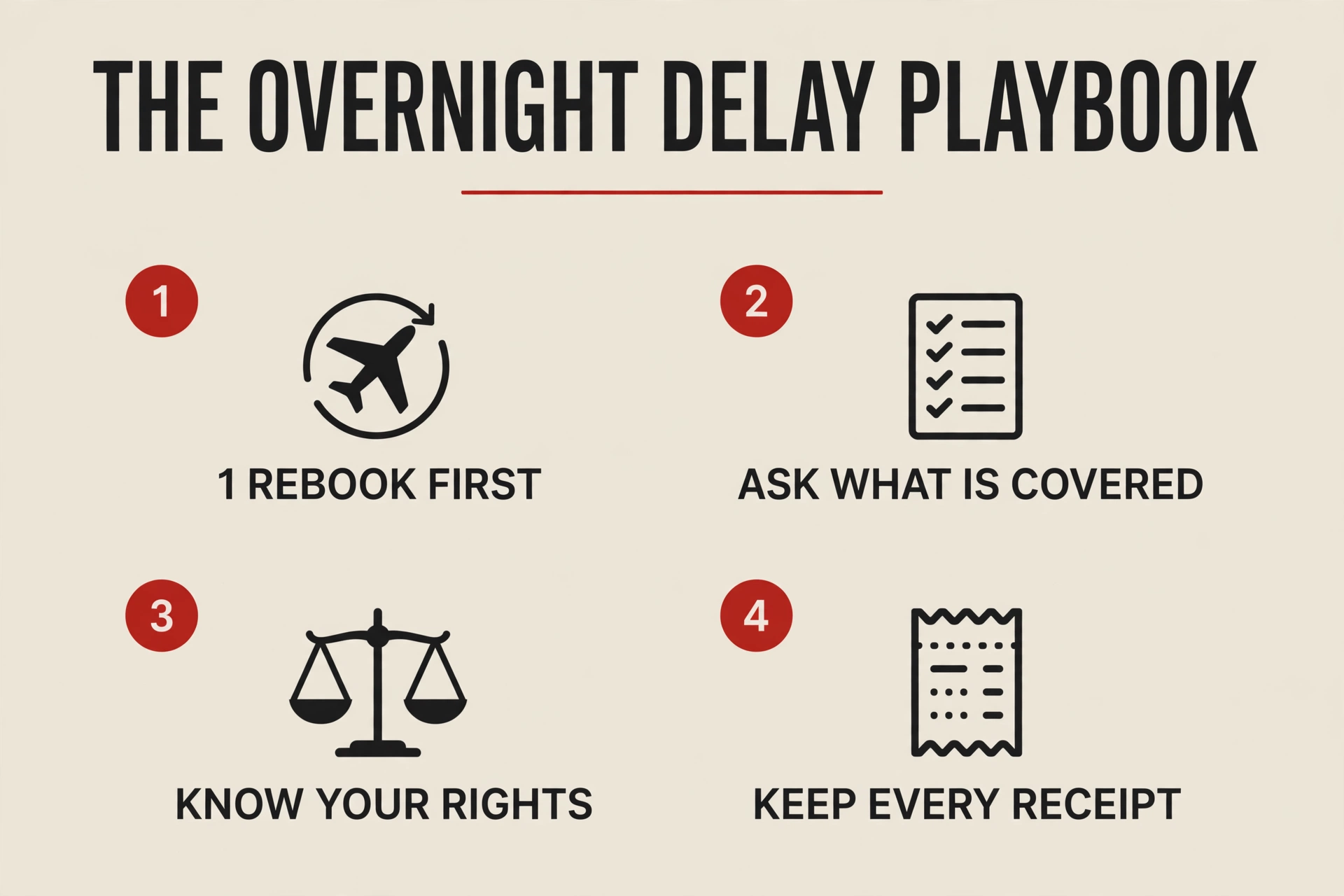
Get rebooked first — everything else can wait
The biggest mistake people make is joining one queue and waiting politely in it. Work three channels at once instead. Join the desk queue — but while you're in it, open the airline's app, which may already have rebooked you, or let you pick a new flight yourself. And call the airline too: a phone agent sees the same seat map as the desk, and the call sometimes gets answered before your queue has moved.
Be flexible. The first flight out tomorrow might route through a hub you'd never choose, but an ugly itinerary home beats a perfect one that leaves you in the terminal another day. Travelling as a group? Check you're all on the same flight — rebooking systems split parties up without mentioning it. Screenshot the confirmation. Then think about tonight
Ask what the airline will cover tonight
Ask this directly: "What are you providing for tonight?" Just ask what they're giving you. The answer might be a hotel voucher, meal vouchers, a taxi code, or some combination.
Two warnings. First, vouchers run out on big disruption nights — if you're offered one, take it and sort the details out later. Second, get things in a form you can prove: the voucher, a confirmation email, at minimum the agent's name. Told to book your own hotel and claim it back? Ask the nightly limit. A verbal "yeah, we'll cover it" at 1 a.m. evaporates by claim time.

Your rights depend on where you're flying
In the EU and UK: the airline owes you care
For flights covered by EU and UK passenger-rights law (broadly, flights departing the EU/UK, plus EU/UK airlines flying in), the airline must look after you during a long delay regardless of the cause — weather included: a hotel for an overnight delay, transport to and from it, meals in proportion to the wait. This duty of care applies even when the airline isn't at fault.
Fixed cash compensation of €250 to €600 (the UK version uses pounds) can also apply under EU261 when you arrive 3 or more hours late and the delay was within the airline's control — a technical fault or a crewing problem, say. The amount depends on distance. Extraordinary circumstances — severe weather, air traffic control strikes — kill the compensation, but not the hotel and meals.
In the US: no delay compensation, but airlines have made promises
The US works differently. No federal law requires cash compensation for delays, however long, or a hotel room. What exists instead: commitments major US airlines have made for delays within their control — mechanical issues, staffing. For a controllable overnight delay, most have committed to a hotel, meals and ground transport. Check exactly what each airline has promised on the US Department of Transportation's delay dashboard — handy for holding an airline to its own words.
One firm rule does exist: if your flight is cancelled and you choose not to travel, you are owed a refund — not just a credit — even on a non-refundable fare. The same right exists in the EU. Take the rebooked flight instead and no refund is due, but your care and (in Europe) compensation rights still stand.
• Meals during a long delay — EU/UK: yes, the airline's duty of care. US: no federal rule; airline commitments cover meal vouchers.
• Hotel for an overnight delay — EU/UK: yes, plus transport to and from it. US: no federal rule; airline commitments cover a hotel.
• Cash compensation for a long delay — EU/UK: €250–€600 if you arrive 3 or more hours late and it was the airline's fault. US: none — no federal delay compensation.
• Refund if cancelled and you don't travel — EU/UK: yes. US: yes — a refund, not just a credit.
• Bad weather caused it — EU/UK: care still applies, compensation does not. US: commitments generally cover controllable causes only.
If you book your own hotel
Sometimes the queue is hopeless, the vouchers are gone, or the airline tells you to sort yourself out and claim it back. Plenty succeed, but treat it like an expense report from the first minute. Confirm coverage before you book if you can: one quick call or message asking "will you reimburse a hotel tonight, and up to how much?" creates a record. Keep the stay reasonable: an airport hotel or somewhere simple nearby, not the penthouse across town. And keep everything — the itemised invoice, taxi and meal receipts, the delay notice, your boarding passes. Photograph receipts as you get them — pockets eat things.

Check your insurance and your credit card
Before paying out of pocket, think about the card you booked with. Many travel credit cards include trip-delay cover, and travel insurance usually does too. They often start paying out after a set number of hours — commonly somewhere in the 6 to 12 hour range, though it varies by policy — and an overnight delay clears that bar easily. The catch is paperwork: insurers typically want proof of the delay from the airline, so screenshot the delay notice or ask the desk for written confirmation, and keep every receipt — this cover almost always works by reimbursement. And you can't claim the same expense twice — if the airline pays for the hotel, it's settled.
Tonight and tomorrow morning
A few things separate a survivable airport night from a miserable one. Keep essentials in your carry-on — medication, a charger, a change of underwear, basic toiletries — because your checked bag may spend the night out of reach. If the airline holds your bag, ask whether it's checked through to the new flight — don't assume.
Charge your phone before you sleep. Set two alarms, worked backwards from the new check-in time with a buffer — tomorrow-you will be tired and far too optimistic. In an airline-provided hotel? Confirm the shuttle time back before bed — the first one fills up fast. And hold on to the paper trail — boarding passes, delay notice, receipts. Claims are much harder to win from memory.
Frequently asked questions
The airline told me to book my own hotel. Can I definitely claim it back?
If they told you to do it and you stayed within a reasonable price, generally yes. In the EU/UK the airline owes you overnight care anyway, so self-booking and claiming is a recognised route. In the US it rests on the airline's commitments and what was said to you — which is why you confirm first, keep the itemised invoice, and note the agent's name. A screenshot beats a memory.
What counts as "extraordinary circumstances"?
Things outside the airline's control: severe weather, air traffic control strikes or restrictions, security emergencies. Ordinary technical faults, crew shortages and knock-on delays don't count — keeping planes working and staffed is considered the airline's job. Even then, the EU/UK duty of care still applies — only the extra compensation falls away.
I was rebooked onto a flight the next day. Do I still get compensation?
In the EU/UK, quite possibly. Compensation is based on how late you actually arrive. Arrive 3 or more hours late on the rebooked flight, with the cause within the airline's control, and the €250–€600 scale can still apply — on top of the hotel and meals. In the US there's no equivalent payment for delays; your remedy is the airline's care commitments, or a refund if the flight was cancelled and you chose not to fly.
What's the real difference between a delay and a cancellation?
For your night at the airport, not much — you need rebooking and a bed either way. For your wallet, a lot. A cancellation triggers the refund right: in both the US and the EU, if the airline cancels and you don't travel, you can insist on your money back instead of a voucher or credit. A delay gives you no such choice — your rights are care (EU/UK) and airline commitments (US) while you wait, plus EU compensation if the lateness and cause qualify.
How long do I have to make a claim?
Longer than most people think, but it varies. In the UK you generally have up to six years; other European countries set their own limits, often between one and five years. In the US, refund disputes go to the airline first, then the Department of Transportation. Practically, file within a few weeks, while you still have the receipts.
One last thing
An overnight delay ruins a day, but it doesn't have to ruin your wallet. The pattern never changes: rebook before the seats go, pin the airline down on tonight before you spend anything, keep every scrap of paper, and know which side of the Atlantic your rights are on — then get whatever sleep you can. That 6 a.m. flight boards whether you're ready or not.