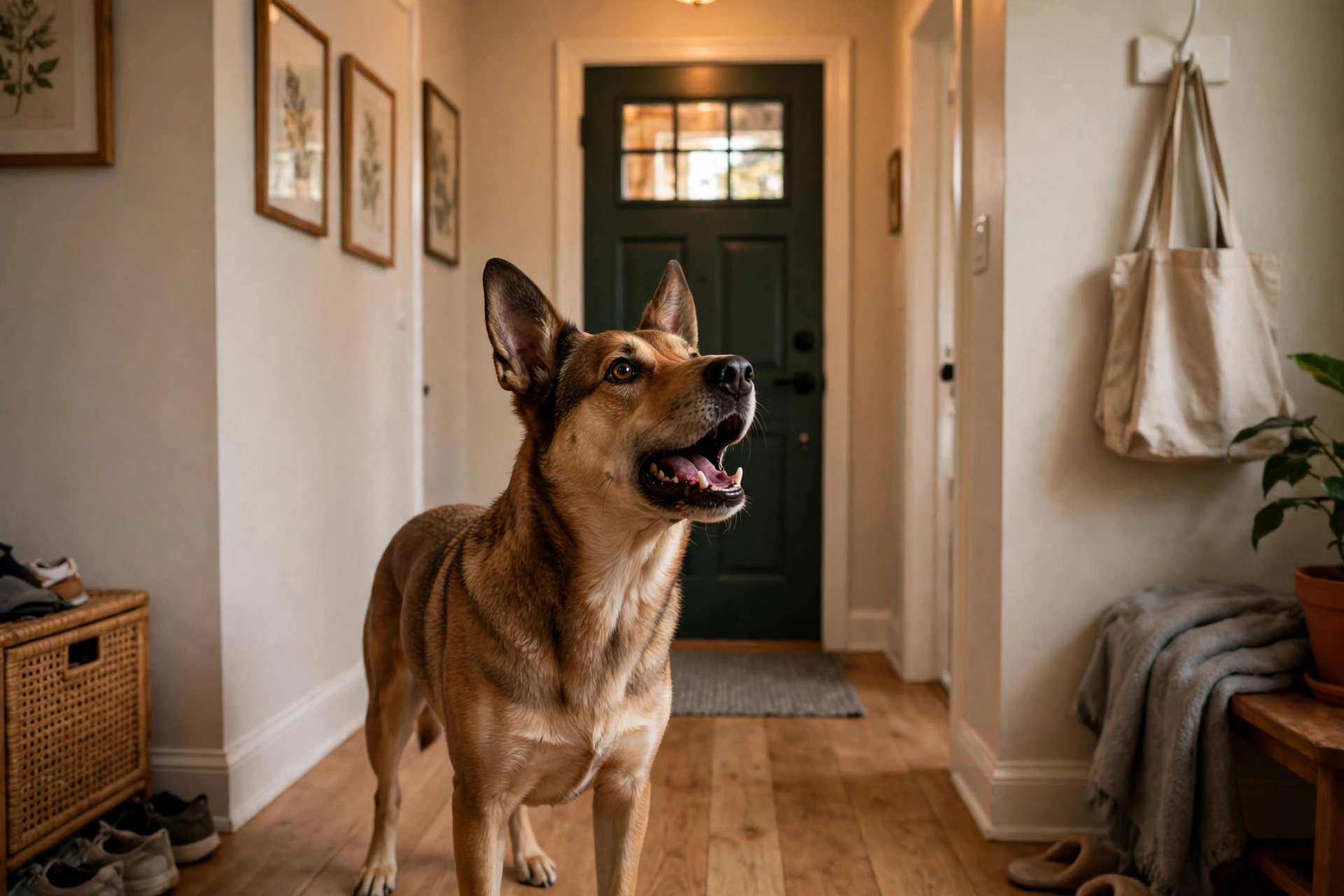
The delivery driver is three steps from the door when it starts. Not a polite warning bark — the full performance. Spinning in the hallway, nails scrabbling, a noise so loud you're shouting "Sorry! He's friendly, honestly!" through the letterbox while the driver backs slowly down the path, parcel still in hand.
If that scene is familiar, the variations owners swap in forums will be too. The dog who sleeps through the postman knocking but loses his mind at a ding-dong sound effect in a TV advert. The dog who barks at the neighbour's bell through the wall, or at one particular phone ringtone. One owner's Labrador ignored real callers for years but went berserk at a pizza advert's doorbell. The bell itself is rarely the whole story; it's what the bell has come to mean.
Short answer
To your dog, the doorbell isn't a sound. It's an announcement: someone is standing at the edge of our territory. And barking at it has worked every time: the person at the door always, eventually, goes away. Your dog doesn't know they were leaving anyway. As far as he's concerned, the barking did that. A behaviour that has been rewarded hundreds of times doesn't fade because we dislike it.
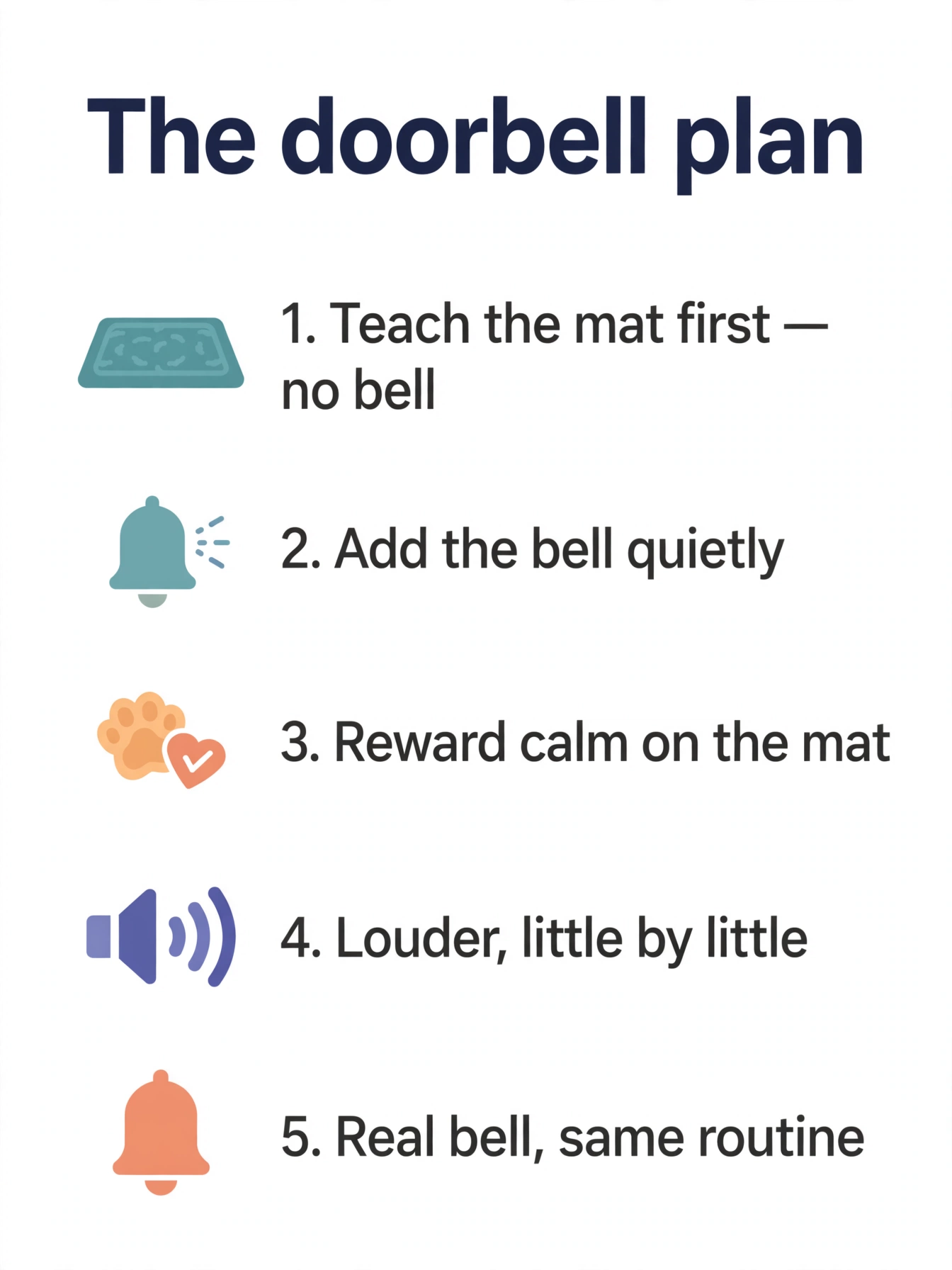
So the fix isn't stopping the barking by force. It's two quieter jobs done together: teach him a different task for bell time — go to a mat or bed, settle, get paid well for it — and make the bell boring by letting him hear it softly, often, with nothing following. Owners who go this route usually report real change within a few weeks of short daily practice; a dog with years of habit takes longer.
Why the doorbell is such a big deal
Plenty of household noises are louder than a doorbell. The washing machine, the hoover, next door's motorbike. Dogs sleep through all of them. The bell is different: a perfect predictor, sounding only when a person is actually there, and never once wrong.
Motivations vary. Some dogs are excited — visitors mean fuss and new smells. Some are genuinely worried: a stranger's shape through frosted glass looks like a threat to move on. From the hallway, the two look almost identical.
And then there's us. When the dog erupts, most of us shout "Quiet! Enough!" over the top of it. He doesn't hear words there. He hears the biggest member of his group barking along, which rather confirms this is a serious event, worth everyone's full effort.
First, rule out the bell itself
Before any training, get control of the sound: record your doorbell on your phone, or find its chime in a sound app. Now you have a bell you can play at any volume, with nobody standing outside. That control is the whole tool.
Do a quick test: with your dog relaxed on the sofa, play the recording at the lowest volume where he notices it. Ears pricking and a head lift is fine — that's registering a sound, not losing control. Note that volume; it's your starting line. If he also reacts to TV bells and the neighbour's, don't despair: that's endless low-stakes practice material in your living room.
Teach the replacement job: go to your place
Pick the spot first: a mat or bed well away from the front door — the far side of the living room, or a kitchen doorway.
Teach it with no bell involved at all. Lure him onto the mat with a treat, pay him for lying down, and repeat in short bursts until "on your place" sends him trotting over and flopping down. Make it the best-paid job in the house.
Only when the mat is solid do you add the sound: the recording at your test volume, cue the mat, reward there. Then, over days, a touch louder. Two good reps beat twenty sloppy ones.
Real deliveries still happen, and a real visitor at full volume is management, not training. Clip a lead on, shut a baby gate, or scatter treats across the kitchen floor so the dog is nose-down hoovering while you deal with the door. Nobody learns anything mid-meltdown.

Desensitising the sound itself
Alongside the mat work, the bell needs to stop being news. That's a slow drip: the recording, played at the volume where your dog notices but stays calm, followed by something good — a treat, a bit of cheese — and then nothing. No door opening, no visitor, no fuss. Just a sound, then normal life resumes.
Raise the volume in small steps across days, not minutes. If the dog goes over the edge (barking, lunging, can't take a treat), the volume jumped too far; drop back to the last level he handled and stay there longer. Owners posting success stories nearly always say the same: the middle stretch feels like nothing happening, and that's exactly when it's working. A realistic first week:
- Day 1: Bell recording at lowest volume while the dog relaxes; treat after each play — done when the dog glances up, then settles again
- Day 2: Same volume, five or six plays across the day — done when the dog barely looks up
- Day 3: Volume up one step; treat after every play — done when the dog hears it and looks to you for the treat
- Day 4: Practise "go to your place" with no bell at all — done when the dog goes to the mat on cue
- Day 5: Quiet bell, cue the mat; treat delivered on the mat — done when the dog settles on the mat after the bell
- Day 6: Bell at near-normal volume, cue the mat, bigger reward — done when the dog stays on the mat while it plays
- Day 7: Helper presses the real bell once; cue the mat, reward heavily — done when you get one calm-ish rep, then stop for the day
When the doorbell rings for real: your routine
Real life won't wait for day seven, so have a routine ready. The first rule: don't sprint. Stand up calmly. Cue the mat. Let the person outside wait ten seconds. Treat the dog on the mat, and only then open the door.
Keep treats within reach of the door, and brief your regulars: family and friends ignore the dog completely until he's on his mat, then fuss him there. Greetings move to the mat — the entire lesson, delivered by life itself.
What not to do
Skip the gadgets. Shock collars and spray collars punish the bark, not the feeling underneath it. A worried dog who gets a shock every time a stranger appears doesn't conclude he should relax; plenty of owners report dogs who conclude strangers bring pain, and get worse.
Shouting adds volume, not information. Telling a dog off after he's stopped teaches nothing either — in dog time you've just scolded the quiet. And visitors fussing him at the door mid-performance pays him for it.
In a flat, one practical addition: warn the neighbours. Thin walls make the problem feel ten times bigger than it is, and most people are patient if a note through the door says you're working on it, practising briefly at reasonable hours.
When it is more than excitement
Most doorbell barking is habit and hype, and responds to the plan above. Some of it, though, is fear, and fear deserves a different level of help. Book a vet check, then a qualified behaviourist, if any of these sound familiar: trembling, drooling or frantic escape attempts when visitors come; barking that has started suddenly in an older dog who was fine before (pain makes dogs reactive); or lunging and snapping at people once the door is open.
There's a run-through of what counts as normal barking and what doesn't in the RSPCA's guidance on why dogs bark, worth reading before you decide which problem you're solving.
Frequently asked questions
Why does my dog bark at doorbells on the TV?
Because to him it's the same sound, meaning the same thing — and TV doorbells are never followed by a person leaving, so the habit gets extra practice. The upside: recorded bells at low volume are exactly this plan's training tool.
How long does this take to fix?
Most owners who practise a few minutes a day report a noticeable difference within a few weeks — the dog still notices the bell, but looks for his mat or treat instead of detonating. A dog with years of habit, or fear-based barking, is a longer project. Consistency in the house matters more than any single session.
Is it different with a puppy?
Easier, mostly, because you're building the habit before the old one sets. Keep sessions tiny, and be strict with visitors: no fussing a puppy who is jumping and yelling at the door; plenty once he's on his mat. What gets rewarded at five months is what you'll be living with at five years.
My dog only barks at the door when I'm out. What then?
That pattern often goes with territory-guarding or separation worries, and you can't train what you can't see: set up a camera and watch what happens. If he's generally unsettled when left (pacing, whining, destruction near the door), that's a separation problem, not a doorbell problem, needing its own plan. Simple management helps either way: radio on, hallway door closed, no view of the street to patrol.
Won't treats just reward the barking?
Timing is everything. You're not paying for barking; you're paying for the mat, the lie-down and the quiet that follows. If the food only ever lands mid-bark, yes, you're funding the noise. If it lands on the mat when the dog has chosen the calm job, you're paying for the work you want.
The bit worth remembering
Your dog is not being defiant. He's doing a job he's been accidentally paid for, in the most convincing currency there is: it worked, every day of his life. Give him a new job with better wages, make the bell as boring as the washing machine, and the front door stops being the loudest thirty seconds of everyone's day.