It is the same miserable scene every time. You are already a few minutes late, you turn the key — or press the button — and instead of the engine catching you get a slow, tired crank, a rapid clicking, or nothing at all. The dashboard lights are dim, or they don't come on. Yesterday the car was perfectly fine. Last week it was perfectly fine. And now, on the coldest morning of the week, it has decided not to start.
Ask around and you will hear the same story from a lot of drivers. The car sits fine all summer, then the first cold snap arrives and the battery gives up. Or it starts on Monday, struggles on Tuesday, and is dead by Wednesday. Or it only ever dies after a weekend parked at the airport, or after a week of five-minute trips to the shops and back. People usually blame the cold, or bad luck. Most of the time it is neither — it is a battery that was already weak, and something in the routine finally pushed it over the edge.

Short answer
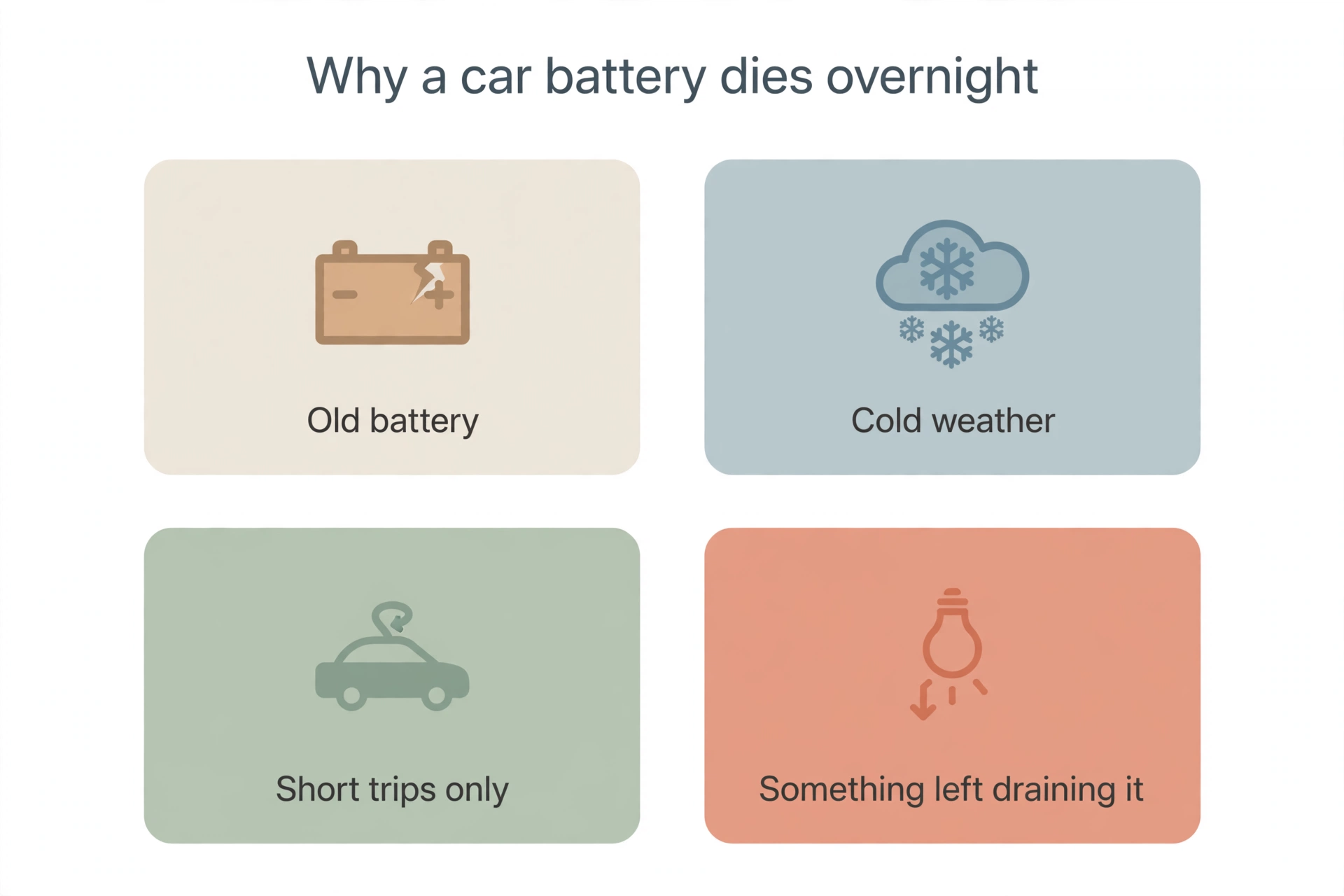
A car battery goes dead overnight for one of four reasons: the battery itself is old and can no longer hold a charge, the cold has slowed it down past the point where it can turn the engine over, the car is only ever driven on short trips so the battery never properly recharges, or something in the car is draining power while it sits parked. A one-off flat battery after leaving the lights on is a mistake. A battery that keeps going flat every morning is a symptom — and the fix depends on which of those four it is. Jump-starting it gets you moving today; it does not fix any of them.
What the car is actually telling you
Before you spend any money, listen to what happens when you try to start it. The sound is a surprisingly good diagnostic, and it costs nothing.
A slow crank that eventually catches. The engine turns over, but lazily, like it is thinking about it. That usually means the battery has some charge left but not enough — it is weak, or cold, or both.
Rapid clicking, lights dimming. You turn the key and get a machine-gun click-click-click while the dashboard lights fade. The starter motor is trying to engage but there is not enough power to turn the engine. Classic flat battery.
One click, then nothing. Or complete silence, no dashboard lights at all. The battery is either fully discharged or a connection has come loose. Check the terminals before you assume the worst — a loose or corroded clamp can look exactly like a dead battery.
It starts fine with a jump, then dies again overnight. This is the important one. If a jump gets you going and the car runs normally all day, the charging system is probably working. The problem is either the battery not holding charge, or something draining it while parked. If it dies again while you are driving, or the battery warning light stays on, that points the other way — at the alternator — and that is a garage job, not a battery job.
The four usual culprits
Most dead-every-morning batteries come down to one of these. Work through them in order — cheapest and most common first.
1. The battery is old. Car batteries typically last three to five years, and age is the single most common reason for a battery that was fine in summer and hopeless in winter. Inside, the plates wear and the battery gradually loses its ability to hold a charge. It can still start the car on a mild day, when the engine turns over easily, and then fail on the first cold morning, when the engine needs far more effort to turn over and the battery can deliver far less. If you don't know how old your battery is, look for a date sticker on the top or side of it — and if the car is on its original battery and it is past four years old, age should be your first suspect.
2. The cold got to it. Cold slows down the chemical reaction inside a battery, so it produces less power just when the engine needs more of it — the oil is thicker, everything is stiffer, and the starter has to work harder. That is why a borderline battery survives October and dies in January, and why the RAC says a vast number of its winter callouts are battery-related. A battery that is healthy will cope. A battery that is already weak will not, and the cold is simply the thing that exposes it.
3. Short trips never recharge it. Starting the engine takes a big gulp of power out of the battery, and the alternator needs a decent run to put it back. A five-minute drive to the shops and back barely replaces what the start took out — and if you do that twice a day, with the heater, lights and heated screen running, you are slowly running the battery down a little further every day. People who work from home and only drive at weekends see this a lot: the car sits for days, then does two short trips, then sits again. The battery never gets a proper charge. The RAC's advice for exactly this pattern is to charge the battery at least once a week during winter with a suitable charger, particularly if the battery is more than three years old.
4. Something is draining it overnight. This is the one people miss, because nothing looks wrong. A boot light that stays on because the switch is faulty. A dashcam wired straight to the battery instead of a switched circuit, recording all night. An interior light left on by a child in the back seat. A phone charger or sat-nav left plugged in. Even the car's own systems — alarm, clock, keyless entry — draw a tiny amount all the time, which is normal. But add one faulty light or one always-on accessory and a healthy battery can be flat in a couple of days, and a weak one overnight. If the battery is new and still goes flat, this is almost certainly where the problem is.
- Slow crank on cold mornings, fine in summer — most likely an old or weak battery plus the cold. What to do first: get the battery tested before winter; replace it if it fails.
- Clicking, dim lights, dead after a weekend parked — most likely a parasitic drain or something left on. What to do first: check lights, dashcam and chargers; test for drain.
- Fine after a long drive, dead after days of short trips — most likely the battery never recharging. What to do first: a longer drive once a week, or a smart charger.
- Starts with a jump, dies again the same night — most likely the battery won't hold charge, or a drain. What to do first: charge fully, then test — if it won't hold, replace it.
- Battery warning light on while driving — most likely an alternator or charging fault. What to do first: a garage — this is not a battery problem.
The quick checks you can do yourself
You do not need a garage to narrow this down. A ten-minute look in daylight will rule out half the possibilities.
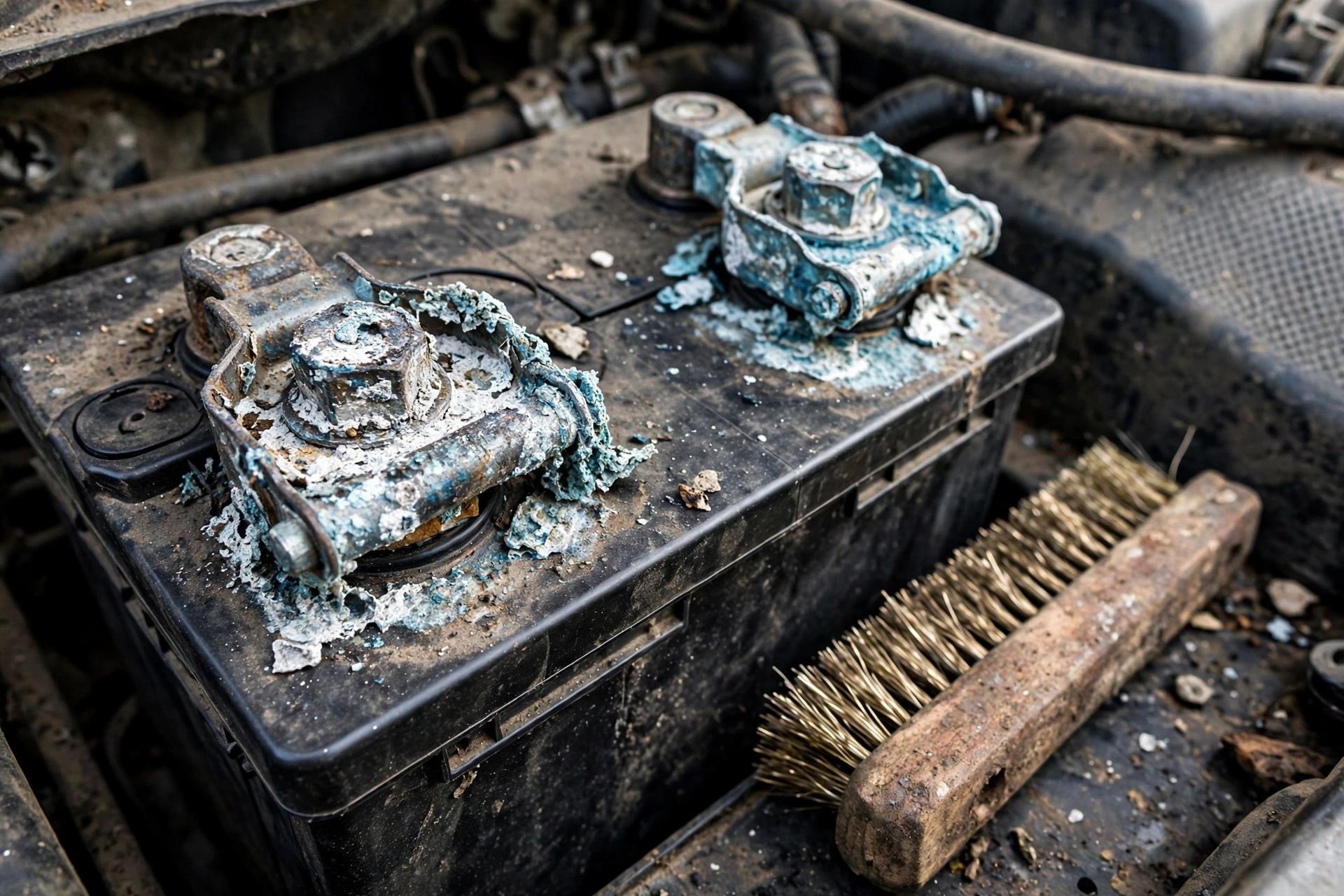
Look at the terminals. Pop the bonnet and look at the two battery terminals. A white or blue-green crusty build-up is corrosion, and it can stop a good battery from delivering power. If the clamps are loose enough to wiggle by hand, that alone can cause a no-start. Corrosion can be cleaned with a wire brush and a little baking soda and water — disconnect the negative terminal first, and put it back last — but if the terminals are badly eaten away, the battery or the cables need replacing.
Check what is left on. Walk round the car in the dark, or in a garage with the lights off. Is there a glow from the boot, the glovebox, or a footwell light? Is the dashcam's little red light still on an hour after you parked? Unplug anything that doesn't need to be there overnight — chargers, dashcams on permanent live, anything in the 12V socket — and see if the next morning is different. If it is, you have found your drain.
Think about the last week. Has the car only done short trips? Has it sat unused for a week or more? Did the problem start after something was fitted — a new stereo, a dashcam, a tracker? The timing usually gives it away. A battery that started dying the week after a dashcam was hard-wired in is not a coincidence.
Get the battery tested. Most garages and auto-parts shops will test a battery for free or for very little, and it is the one test that settles the argument. A load test shows whether the battery can actually deliver power under strain, not just what voltage it shows sitting still. A battery can read a healthy-looking voltage and still fail a load test — that is what "won't hold a charge" means. If it fails, no amount of charging will bring it back for long, and replacing it is cheaper than another week of jump starts and missed mornings.
Jump-starting it properly, and what not to do
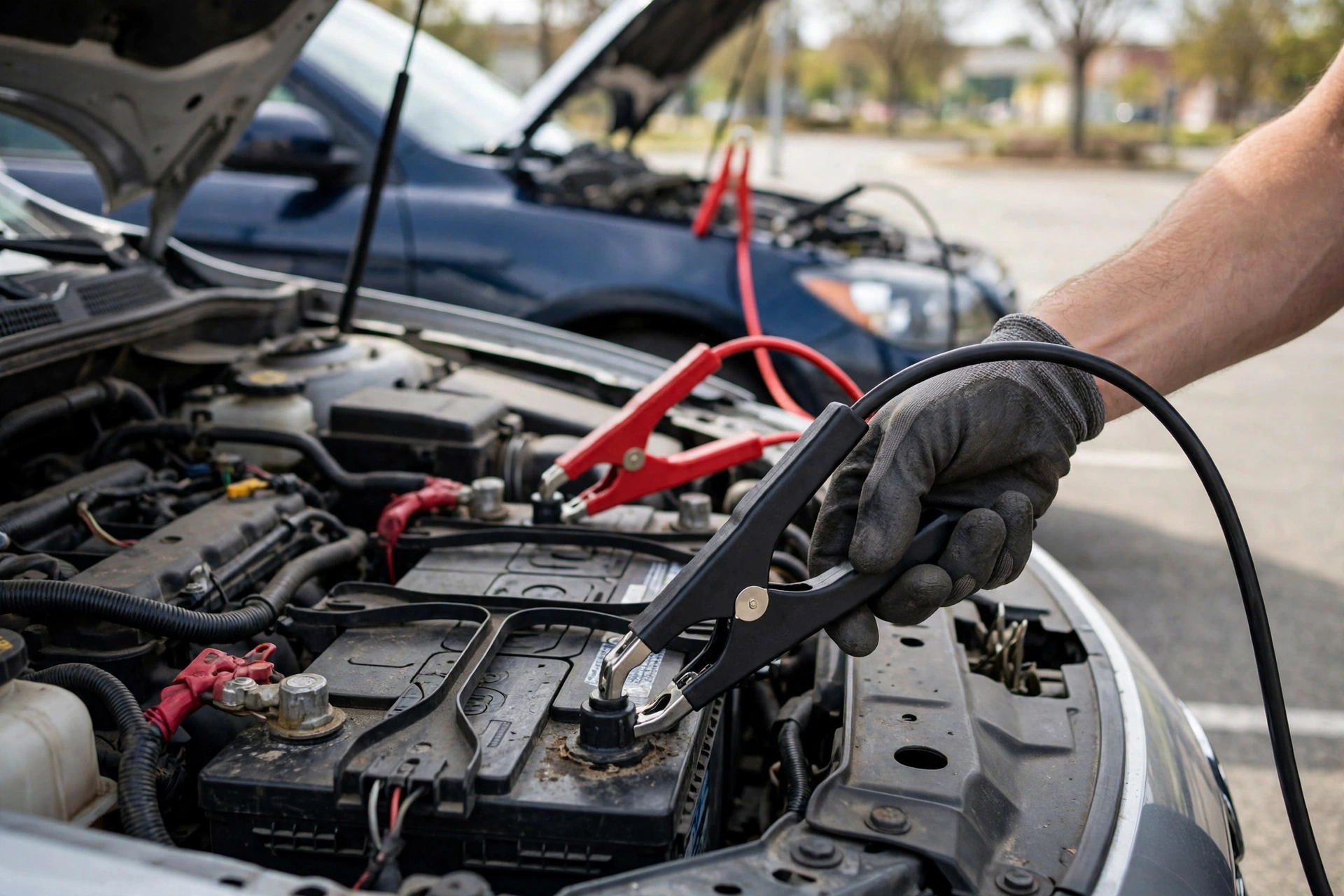
If you need to get moving this morning, a jump start from another car or a portable booster pack will usually do it. The order matters, and getting it wrong can damage both cars' electronics, so it is worth doing slowly even when you are in a hurry. Connect the red lead to the dead battery's positive terminal, then to the good battery's positive. Connect the black lead to the good battery's negative, then to a bare metal part of the dead car's engine block — away from the battery itself. Start the good car, wait a couple of minutes, then try the dead one. Once it is running, remove the leads in reverse order, and then drive for at least 20 to 30 minutes — a proper run, not a crawl to the shops — so the alternator has a chance to put some charge back in.
Two things not to do. Don't keep cranking the engine over and over when it won't start — each attempt drains the battery further and can overheat the starter. Give it a few seconds between tries. And don't jump-start a battery that looks swollen, cracked, leaking, or smells strongly of rotten eggs. That is a damaged battery, and jump-starting it is not safe — call for help instead. The RAC's flat-battery guide walks through the same steps, and it is worth reading once before you ever need it in a dark car park: What to do if you have a flat or dead battery
Stopping it happening again
Once you know the cause, the fix is usually straightforward — and cheaper than the mornings it costs you.
If it is age, replace it before winter, not during it. A battery that fails a load test in November will not get better by February. Buy the right size and specification for your car — the handbook or the old battery's label tells you what you need — and if your car has stop-start, it needs the right type of battery for that system, not just any battery that fits. A new battery is one of the cheaper car repairs there is, and it is a lot cheaper than a tow.
If it is short trips, give it a proper run. One decent drive a week — 30 minutes or more, at a steady speed, with the heater and heated screens used sparingly — does more for the battery than a dozen five-minute trips. If the car is barely used at all, a smart charger or maintainer, plugged in every week or two, keeps the battery topped up without overcharging it. The RAC's cold-weather guide makes the same point for winter driving generally: switch off lights, wipers, heater and radio before you turn the engine off, so they are not all drawing power the next time you start up — Car won't start in the cold? Possible causes and preventative tips
If it is a drain, find it before you replace the battery. A new battery will go flat just as fast if something is still draining it overnight. The proper test uses a multimeter to measure the current draw with the car locked and asleep — most cars settle to a very small draw, and anything much above that means something is awake that shouldn't be. Pulling fuses one at a time while watching the reading shows which circuit holds the culprit. It is a fiddly job, and if you are not comfortable with a multimeter, a garage will do it in under an hour — and it is money well spent compared with replacing a battery that was never the problem.
Park under cover if you can. A garage, or even a carport, keeps the worst of the overnight cold off the battery. It will not save a dying battery, but it takes the edge off the coldest mornings. And in winter, switching off the heated seats and screens once they have done their job, rather than leaving them running for the whole journey, leaves more charge in the battery for the next start.
Frequently asked questions
My battery died once — do I need a new one?
Not necessarily. A single flat battery after leaving the lights on, or after the car sat for three weeks, can often be recharged and carry on normally. The test is what happens next: charge it fully, drive it normally for a few days, and see if it holds. If it goes flat again without an obvious cause, get it load-tested. One flat is an incident; two flats is a pattern.
Can I just keep jump-starting it?
You can, for a while, and a lot of people do. But every deep discharge shortens a lead-acid battery's life, so a battery you keep jump-starting is a battery getting weaker every time. It is also a gamble — the morning it doesn't start will be the morning you are already late. If it has needed jumping more than twice, stop patching it and get it tested.
How long should a car battery last?
Typically three to five years, depending on the climate, how the car is used, and the battery itself. Heat is actually harder on batteries than cold over the long term, but cold is what exposes a weak one. If yours is past four years and starting to struggle, budgeting for a replacement before winter is sensible, not wasteful.
Will a longer drive fix a flat battery?
A good long drive will recharge a healthy battery that went flat for a simple reason, like lights left on. It will not fix a battery that can no longer hold a charge, and it will not fix a drain. Think of it this way: the drive refills the tank, but if the tank has a hole in it, refilling doesn't help for long.
Is it the battery or the alternator?
The simplest split: if the car jump-starts, runs fine all day, and then won't start the next morning, the battery or a drain is the likely problem. If the battery warning light comes on while you are driving, the lights dim as you drive, or the car dies while running, suspect the alternator — the part that charges the battery while the engine runs. That one needs a garage either way.
The bit worth remembering
A battery that is dead every morning is not being difficult — it is telling you something specific. Old age, cold, short trips, or a quiet drain: one of those four is almost always the answer, and the morning's symptoms will usually point at which. Test the battery before you replace it, find the drain before you blame the battery, and give the car a proper run once in a while. Most of the time the fix is a test, a charger, or a new battery — not a mystery, and not a garage bill you need to dread.