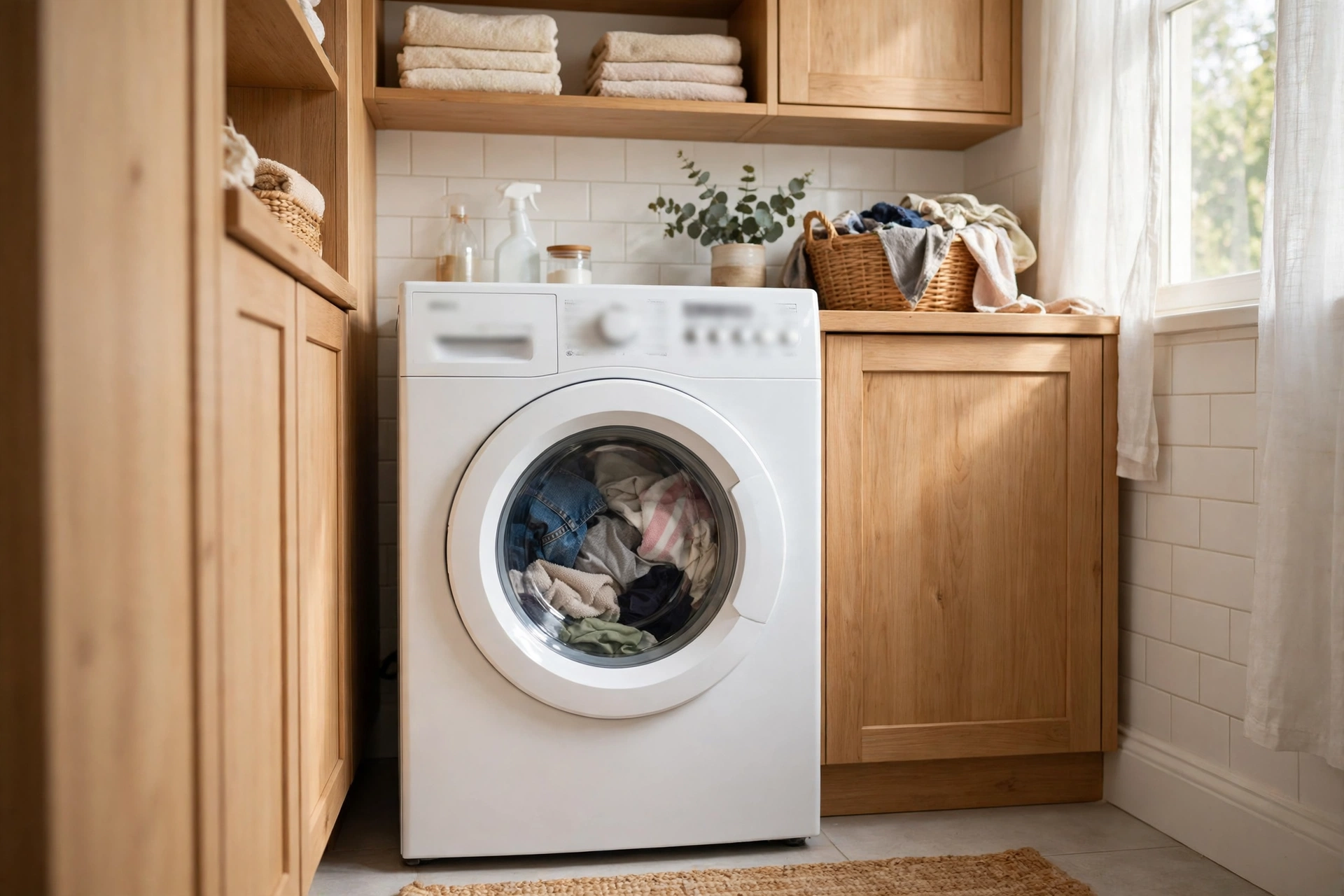
It usually starts with a noise you can feel through your shoes: a deep thump, then another, then the whole machine rocking like it's trying to escape the laundry room. Ten minutes later it's sitting two inches from where it started, drain hose stretched tight behind it.
If that sounds familiar, you're in good company. A machine that shakes, bangs, or walks across the floor is one of the most common appliance complaints there is — and the cause is rarely serious. Most of the time it's a load bunched up on one side, feet that aren't level, or, on a new machine, bolts that were meant to come out on day one and never did.
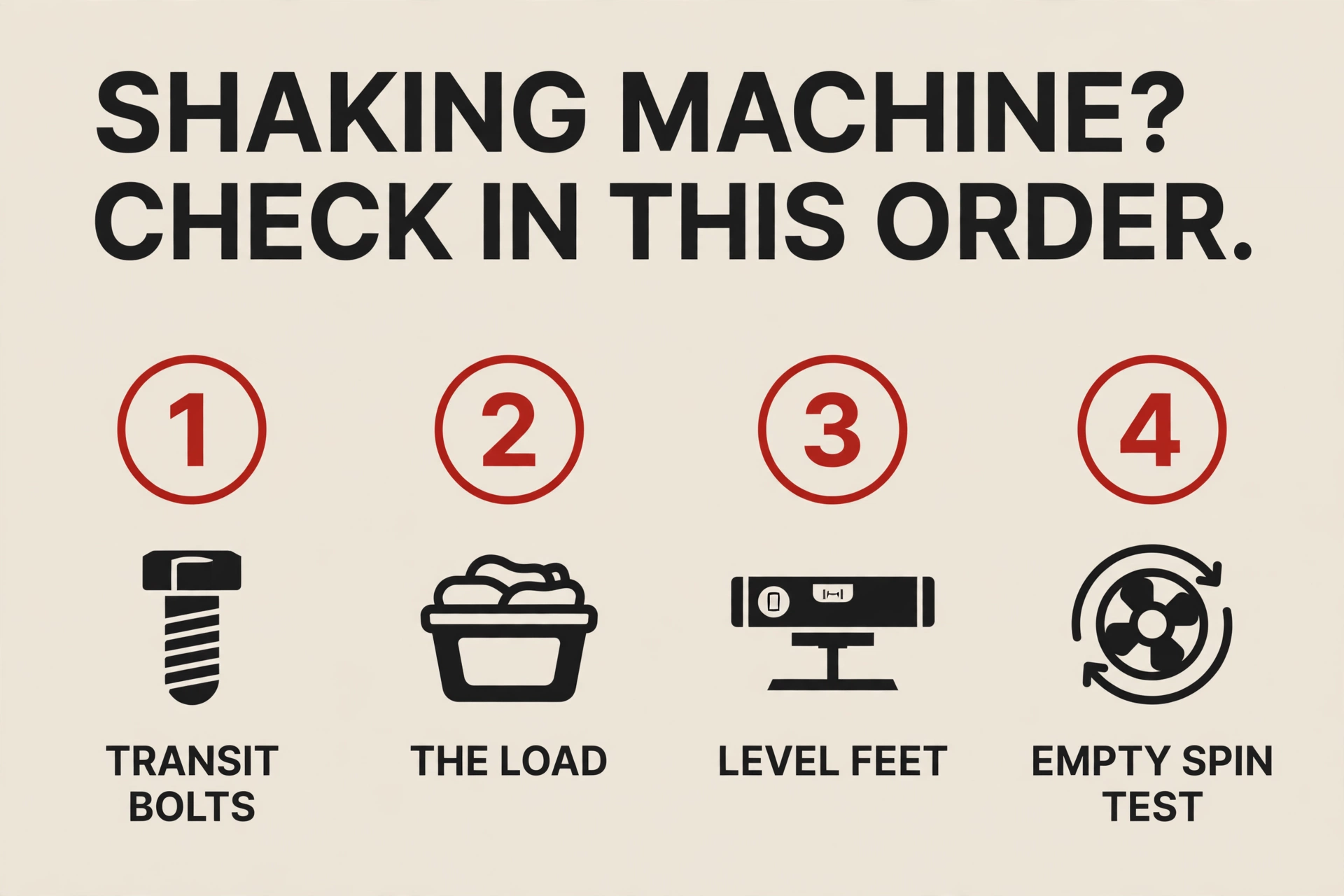
Work through the checks below in order — cheapest and most common first, worn parts last, where they belong.
Short answer
A washing machine shakes and walks when the spinning drum is out of balance or the machine can't sit solidly on the floor. The usual culprits are transit bolts left in on a new machine, one heavy item throwing the load off, or feet that aren't level and locked. Run an empty spin cycle to separate a load problem from a machine problem, and only suspect worn suspension or bearings if it still bangs with nothing in it.
Check the transit bolts first on a new machine
If your machine has shaken violently from its very first wash, this is almost certainly your answer. Machines ship with transit bolts — three or four chunky bolts through the back panel that lock the drum in place for the truck ride. They're meant to come out during installation, with plastic caps covering the holes.
If they're still in, the drum can't move on its suspension as designed. The cabinet takes the full impact instead, and the machine thumps, jumps, and wanders.
Look at the back. Bolts with rubber spacers still in place? That's it. Unplug the machine, take them out — keep them, you'll need them if you ever move house — push the blanking caps in, and run a wash. The difference is usually night and day. Installers and DIY movers miss this more often than anyone admits.
Look at what you're actually washing
The drum balances itself by spreading the load around the tub as it spins. Fine with a normal mixed load; badly with one heavy item.
A single bath mat, a chunky blanket, a pair of trainers with a towel, or a duvet cover that has swallowed everything else into a wet ball — any of these can leave most of the weight sitting on one side. The machine tries to redistribute it, gives up or doesn't, and spins anyway. That's when the thumping starts.
The fix costs nothing: wash heavy items with similar-weight things, fill the drum no more than three-quarters, and if a load sounds wrong, pause and untangle it by hand. If it only ever misbehaves with one item, that's your answer — not mechanical.
Rock it: the levelling check
A machine that isn't level, or isn't sitting firmly on all four feet, will rock — and a rocking machine is a walking machine, because every wobble shifts it slightly across the floor.
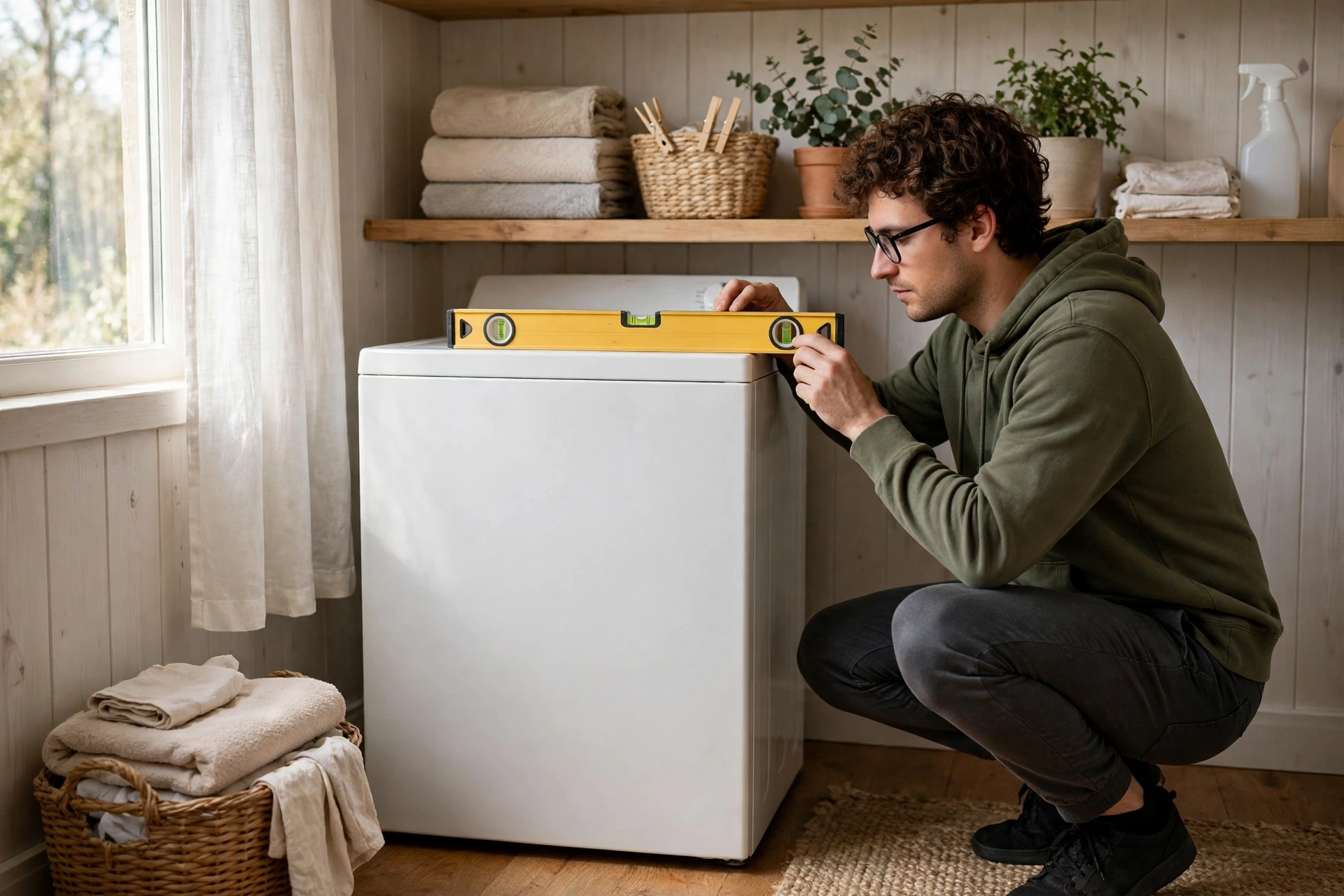
Start with the rock test. Put a hand on opposite corners of the top and push down, then switch to the other two corners. Any movement, however slight, means a foot isn't carrying its share.
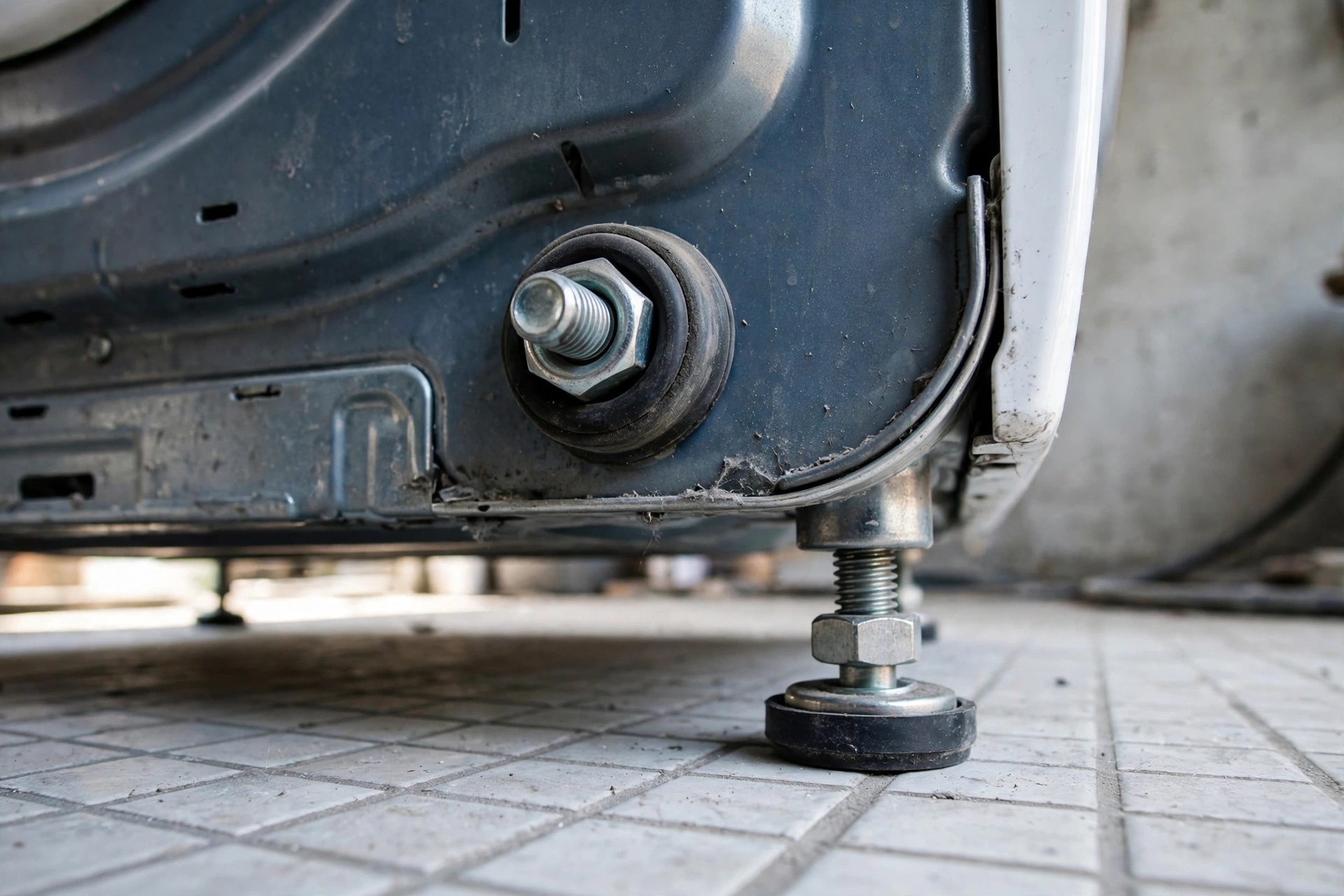
Front-loaders have adjustable front feet and usually fixed or adjustable rear ones. Loosen the lock nut, turn the foot to raise or lower that corner, and work around until the rocking stops and a spirit level sits flat across the top. Then — the step people skip — wind the lock nuts back up tight against the cabinet. Unlocked feet slowly unscrew themselves with vibration, and you'll be redoing this in three months.
In a tight corner, pull the machine out to work, level it, slide it back, and re-check — sliding can knock a foot out.
The empty-spin test
This is the most useful five minutes you can spend, because it splits the problem cleanly in two.
Empty the drum completely, close the door, and run a spin-only cycle at full speed. Then watch and listen.
If it spins smoothly, the machine is fine — your problem is loads, and how you fill it. If it still thumps, vibrates hard, or creeps across the floor with nothing in it, the problem is in the machine or under it: levelling, the floor, or worn parts.
Note where it happens, too — vibration only as the spin climbs, or banging at one steady point, gives whoever looks next a real head start.
Blame the floor, at least partly
Some machines shake because the floor gives. Wooden floors, especially upstairs or in older houses, flex under a spinning load and act like a springboard — the machine bounces, and the whole house feels it. Tile or concrete is much kinder.
You can't rebuild the floor, but you can change how the machine meets it. A thick rubber anti-vibration mat, or pads under each foot, soaks up a surprising amount of movement and stops most of the walking. Just check the machine still sits level afterwards.
Position matters too: a machine mid-span on a wooden floor bounces far more than one pushed back towards a wall, where the joists are supported. If your layout allows it, that move alone can calm things down.
Worn parts on older machines
If the machine is level, the load is fine, it still bangs on an empty spin, and it's more than a few years old, you're probably looking at wear.
On top-loaders the drum hangs from suspension rods; when they wear, the tub swings too freely and strikes the cabinet. On front-loaders, springs and damper legs do the holding, and worn dampers let the drum bounce instead of settling.
Bearings are the other suspect. They don't usually cause much walking on their own, but they announce themselves clearly: a rumbling that builds with spin speed, and play in the drum. Lift the inner drum gently at the front — if it moves against the outer tub, or feels gritty turning by hand, the bearings are going.
Any job that involves opening the cabinet starts the same way: unplug the machine before removing any panel, every time, no exceptions for a "quick look."
Symptom, cause, fix
- Violent shaking from the very first wash — transit bolts still fitted. Fix: remove the bolts from the back panel and fit the blanking caps.
- Thumps only with certain loads — one heavy item or a bunched-up load. Fix: rebalance the load; wash heavy items with similar-weight pieces.
- Machine rocks when you push a corner — uneven or unlocked feet. Fix: adjust the feet until solid, then tighten the lock nuts.
- Banging even on an empty spin — worn suspension, dampers, or bearings. Fix: inspect or book a technician.
- Whole floor bounces, house feels it — flexible wooden floor. Fix: anti-vibration mat or pads; move the machine nearer a wall.
- Rumbling that grows with spin speed, drum has play — worn drum bearings. Fix: a technician job in most cases.
When to stop and call a technician
Most shaking problems end at the checks above. Call someone in when you see any of this: the machine still bangs hard on an empty spin after levelling, there's a burning smell or a grinding noise, water is leaking, the drum has obvious play in it, or the machine trips the electrics.
Bearings and suspension work is genuinely awkward on many machines — drums come out, seals get disturbed, and a small mistake becomes a leak. A good technician will also tell you when a repair costs more than the machine is worth, which on an older model is worth hearing before you spend anything. Samsung's own troubleshooting page for a washing machine that is shaking too much walks through the same checks in the same order.
Frequently asked questions
Is it bad for the machine to keep using it while it shakes?
It isn't good for it — that vibration is also hammering the suspension, door seal, hoses, and connections. Ignore it and you often end up with a leak or a bigger failure later. The checks above take an afternoon at most.
Why does my machine only walk on the fastest spin?
Because that's when an out-of-balance load has the most energy. A small imbalance you never notice at 800 rpm becomes a thumping, travelling machine at 1400. Try a slower spin for heavy loads and see if the behaviour changes — that alone points at the load rather than the machine.
Can I just put something heavy on top of the machine?
No. Weight on top doesn't fix an imbalance or a levelling problem, and it can dent the cabinet or damage the controls. Anti-vibration pads go underneath the feet, not on top of the lid.
Do anti-vibration pads actually work?
On flexible floors, yes, often noticeably — they stop the machine gripping and releasing the floor, which is what makes it creep. On a solid floor with a level machine they do less, because the problem usually lies elsewhere.
My machine is new and level but still shakes. What now?
Check the transit bolts again — seriously, this is the answer far more often than people expect. If they're out and it still jumps on an empty spin, use the warranty; opening a new machine up yourself can void your cover.
The bottom line
A walking washing machine is almost never a dying washing machine. Start at the back panel, run the empty-spin test, and spend your effort on loads and levelling before you spend money on parts. Most people find the culprit within the hour — and the machine stays where they left it.