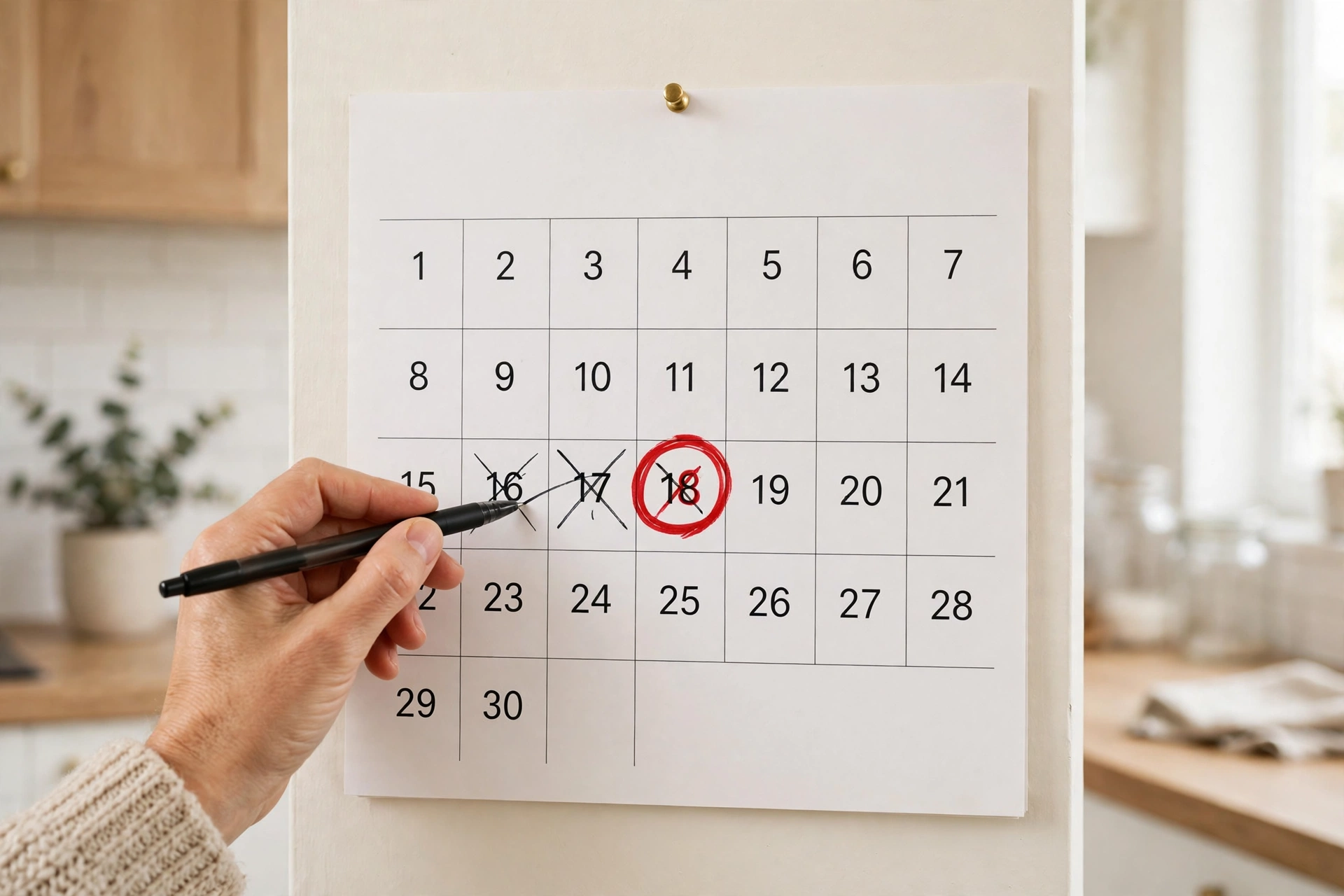
The calendar on our fridge has a red circle around a Saturday in October, and it has been there since February. Inside the circle, in my wife's handwriting, are two words: "Keys day." That's the morning we pick up the keys to a house we have been saving towards for six years. Every evening one of us crosses off another square, and the number left feels a little more real than it did the day before.
You probably have your own version of that red circle. A wedding circled since the engagement. A due date counted in weeks, then days. A flight home to see somebody you have missed for far too long. The countdown is rarely about the maths. It gives a long, shapeless wait an edge you can hold on to.
Short answer
Work out the exact number of days between today and the event, write it down somewhere you will see it daily, and knock one off every morning. Most countdown apps show days remaining, so today does not count and the event day itself is day zero. Get that number right at the start, because an off-by-one mistake on day one follows you all the way.
Why a number makes the wait easier
A long wait with no shape to it is hard work. "Sometime next spring" drifts, and your brain has nothing to measure, so the event feels permanently far away and permanently vague at once.
A number fixes that. Sixty-three days is something you can watch shrinking. It turns waiting, which feels passive, into progress, which does not.
That is why people count down to almost everything. Weddings and due dates, obviously. Exams, moving day, a visa appointment, the holiday booked eleven months ago, the date a partner comes home from working abroad. One man described counting down his final ninety days to retirement on a calendar in his locker, after thirty years of shifts. The last month felt easier than the ten years before it, because he could see the end.
Get the number right first
Before the fridge door, before the widget, before anything: get the starting figure right, because this is where most countdowns quietly go wrong. The number of days between today and your event is not the same as counting today and the event day as well. That second method, inclusive counting, quietly adds one.
Take a simple example. Say today is the 1st of the month and your event falls on the 31st of the same month. The number of days between those two dates is 30. But count the 1st itself, then every day after it, and the 31st too, and you get 31. Same calendar, same event, two different answers.
Most countdown apps show days remaining, so they do not count today. Event tomorrow means one day to go; on the morning itself, zero. Copy that convention and you will never be standing there a day early, wondering where everybody else is.
If counting squares on paper makes your head spin, stop and double-check the figure properly. A friend counting down to her sister's wedding swore blind there were 84 days to go, announced it in the family group chat, and had to correct it to 83 a day later. Tools like CalcZila's free online calculators exist for exactly this sort of sanity check, and two minutes there beats weeks of being one out.

Counting by hand, and where it goes wrong
Plenty of people still do it the old way. Just know the weak spots.
Counting squares on a wall calendar is the classic method: lovely, physical and slow. It is also surprisingly easy to fumble. Months do not all have the same number of days, and the mistakes nearly always happen at the joins between them. People forget that February is short. They give April 31 days, or assume every month works out at a tidy thirty. One wrong square in March and your June countdown has been lying to you for weeks.
Counting in weeks is the other manual method, fine for a rough figure: whole weeks times seven, plus the leftover days. Ten weeks and three days away is 73 days. Switch to an exact count once the date gets near.
Tools and widgets that do the ticking for you
Once you trust the starting number, the daily part can look after itself. A phone home-screen widget is the laziest option and, for most people, the best one: it sits next to your clock, quietly dropping by one every midnight. For a number you can trust underneath that widget, I tend to run the two dates through a days between dates calculator once at the start, note the figure, and then let the phone handle the rest.
Beyond the phone, you have choices. Crossing days off a paper calendar is still the most satisfying method ever invented, because the pen makes it official. A paper chain works brilliantly for children: one loop snipped off each morning, the chain visibly shrinking. A jar of folded notes, one to open each day, suits slower countdowns. A shared countdown in the group chat turns one person's wait into everybody's.
- Phone widget — Solo travellers — Effort: almost none
- Paper chain — Kids — Effort: one crafty afternoon
- Wall calendar, crossed off — Couples — Effort: ten seconds a day
- Group-chat countdown — The whole office — Effort: a photo now and then
- Jar of folded notes — Couples and family — Effort: an hour, once
When the countdown is longer than 100 days
Daily counting has a limit, somewhere around three months. At 240 days, knocking off one day changes almost nothing, and staring at a number that barely moves can make the wait feel longer instead of shorter.
So count in a bigger unit. Weeks work well at that distance. Milestones work even better. Break the wait into stages with their own little finishes: bookings made, paperwork sent, halfway day, thirty days to go, final week. A couple counting down 200 days to a wedding ignored the daily number entirely and celebrated the milestones instead, including a deliberately daft halfway party at day 100.
And the halfway point deserves its reputation. Past it, you are no longer mostly waiting with a bit done. You are mostly done, with a bit of waiting left.

Counting down with small children
Children cannot feel a month. To a four-year-old, "in six weeks" and "next year" are roughly the same country. Make it visual and physical instead: the paper chain works because a child can see Tuesday get shorter, and a row of stickers or a jar of marbles emptying one by one does the same job.
And steal the trick parents swear by: count sleeps, not days. "Three more sleeps until Grandma comes" lands in a way "three more days" simply does not, because a sleep is an event a small child understands. Plenty of adults quietly use the same trick before a big trip, and there is no shame in it.
The last week, when the number gets small fast
Something odd happens under seven days. The number that crawled for months suddenly sprints, and anticipation can tip into panic. The fix is boring and it works: a tiny checklist, written before the final week starts.
Put the unglamorous things on it. What needs packing, booking, charging, printing or confirming. Who needs telling. What time you actually need to leave, rather than the optimistic version. One page, ticked off in pencil, is enough. If the event involves a flight, add one more line to the page: know what to do when your flight is delayed overnight, because an airport at midnight is no place to start reading.
Then let the last few days be the last few days. Enjoy the strange, fizzy bit at the end, because it is part of the event too.
Frequently asked questions
Should the countdown include today or not?
Follow the apps: do not count today. Days remaining means whole days still to pass, so tomorrow's event is one day to go and the day itself is zero. Counting today adds one and leaves you a day ahead of everyone else.
What is the easiest way to check my day count is right?
Do it two different ways and see if they agree. If the answers differ by exactly one, you have counted both the first and last day in one of them. The days-between figure is the one to use.
How do I count down with a toddler who cannot read numbers?
Count sleeps, and make it something they can touch. A short paper chain, a line of stickers, or a jar that loses one marble a day all work. Keep it short enough to see shrinking; a long chain means as little to a small child as a number does.
Is a countdown app better than a paper calendar?
Neither, honestly. The app is accurate and effortless, and it will never forget February has 28 days. The calendar is slower and more satisfying. Plenty of people run both: the app for the true number, the calendar for the pleasure.
What should I do when the countdown ends and I feel oddly flat?
That flat feeling has a nickname among travellers: the post-trip blues. Put the photographs somewhere you will see them, tell the stories while they are fresh, and, when you are ready, give yourself a new date to look forward to. It does not need to be big. It just needs to exist.
The wait is part of the story
Ask people about a wedding, a baby or a long-planned trip a year later, and notice how often the story starts before the day itself. The fridge calendar. The chain getting shorter. The group chat at single figures. The counting was never dead time; it was the build-up, the drumroll. Count it properly, count it in sleeps if you have to, and enjoy being somebody with something worth waiting for.