
Almost every house share has the same unspoken rule at the start: nobody wants to be the one who brings up money. It feels awkward. So the conversation gets postponed, someone covers a bill "just this once," someone else assumes the big bedroom costs the same as the box room, and three months later there's a frosty silence over a washing-up rota that is not really about the washing up at all.
The pattern is painfully familiar. Rent day arrives, one person ends up chasing the others in the group chat, and whoever covered the internet bill starts keeping a private mental ledger. Not over the amount, usually. Over the feeling that it's uneven and nobody will say so.
None of this needs a complicated system. It needs one honest conversation, a method everyone has agreed to, and a routine that runs the same way every month.
Short answer
Pick one rent method — equal, by room size, or by income — and agree it together before move-in day. Split utilities per person, put one person in charge of each bill, and set a fixed date every month when everyone transfers their share. Then write the whole thing down in a few lines. Most roommate money fights are not about being cheap; they're about the rules only existing in someone's head.
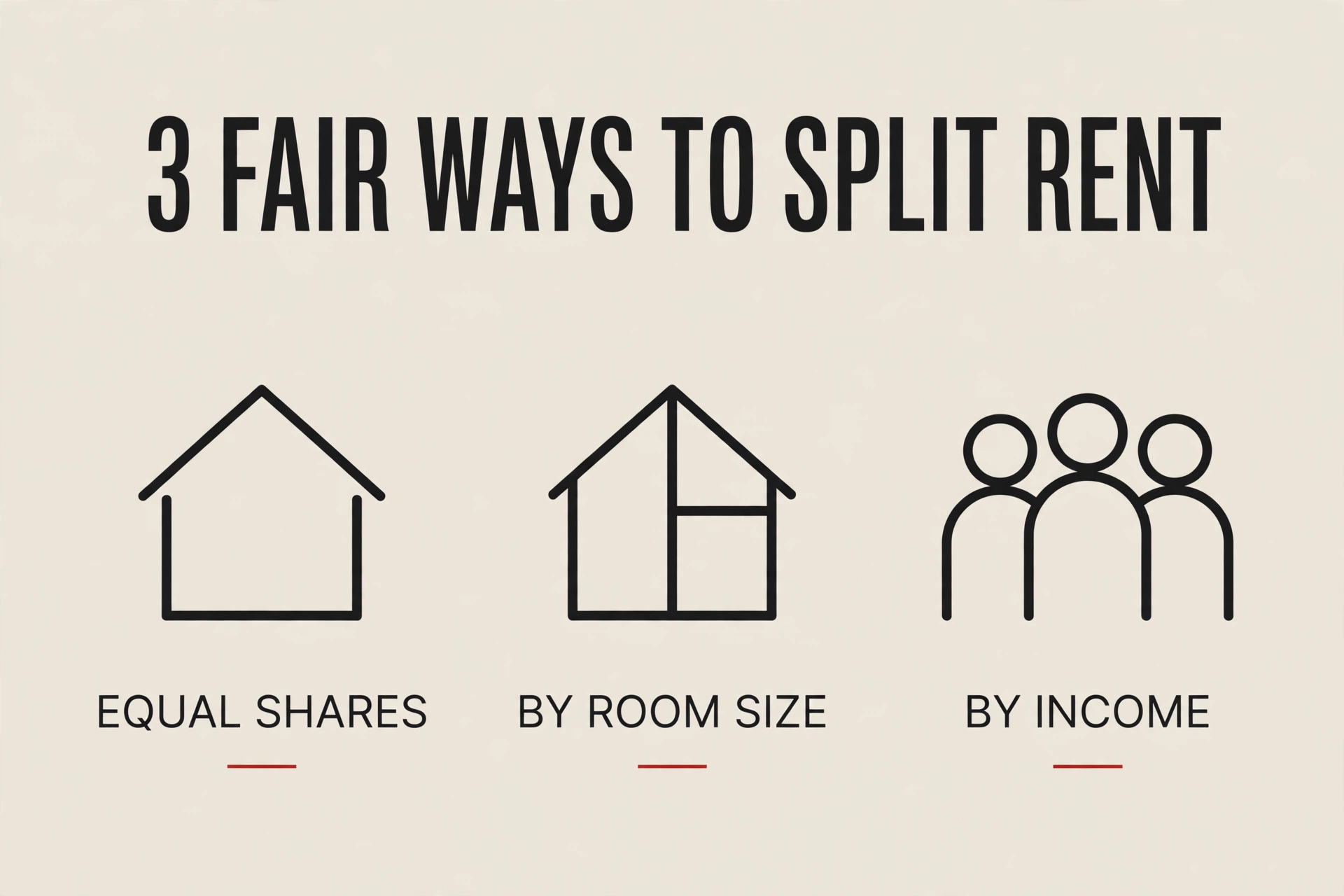
The three ways to split rent
There's no single correct answer here, just trade-offs. What matters is that everyone picks one on purpose, rather than drifting into whatever happened in month one.
Split it equally
Everyone pays the same amount, no measuring, no debate. This works brilliantly when the bedrooms are roughly the same size and nobody has a perk like an en suite or the parking space. It's also the method least likely to start an argument, because there's nothing to argue about.
The catch shows up fast when the rooms aren't equal. If one person has a room you can barely fit a bed in and another has space for a desk, a sofa, and a small country, equal shares quietly stop feeling equal. The small-room person won't say anything for months. Then, one day, they will — all at once.
Split it by room size
Here, rent follows square footage: bigger room, bigger share. It feels objectively fair, and where the rooms genuinely differ, it usually is.
The downside is the measuring itself. Ignore the common areas and split only by bedroom size; that's the version that stays simple. Expect one tense evening with a tape measure; it's worth it.
Split it by income
If one roommate earns twice what another does, equal shares don't land equally. An income-based split takes a set percentage of each person's pay, so the burden feels similar even when the amounts differ. For a house with a student or a part-timer in it, this is often the only split that holds together.
It's also the most personal option, and not everyone wants to discuss payslips with people they found on a listings site. A halfway version works well: agree rough bands ("you earn a lot more, so you take 40%") without anyone handing over exact numbers. If the roommates aren't close, this one can feel like too much trust too early.
A worked example, with real numbers
Say the rent is $1,500 a month and three roommates have private bedrooms of 300, 250, and 200 square feet — 750 square feet in total. An equal split is easy: $500 each. A size-based split works room by room: the 300 sq ft room is 40% of the total, so it pays 40% of $1,500, which is $600. The 250 sq ft room pays $500, and the 200 sq ft room pays $400.
- Roommate A — 300 sq ft room: $500 on an equal split, $600 split by size.
- Roommate B — 250 sq ft room: $500 either way.
- Roommate C — 200 sq ft room: $500 on an equal split, $400 split by size.
Look at Roommate C. Under the size split they save $100 a month — $1,200 over a year — which is real money, and reason enough to do the maths. Roommate A pays more but gets the room with actual space in it, and knows precisely why.

Utilities and shared supplies are a different problem
Rent is one fixed number. Utilities wander. The cleanest approach for most bills — electricity, water, internet — is an even split per person, because usage is too tangled to meter fairly. In that same household: an electricity and internet total of $180 for the month splits to $60 each. Done in ten seconds.
There are reasonable exceptions. A roommate who works from home five days a week does use more electricity and heating, and a small agreed top-up is fair if it's raised once and then dropped. What doesn't work is itemising every long shower and gaming session — the moment bills become surveillance, the house stops feeling like a home.
Shared supplies — toilet paper, dish soap, bin bags, the light bulbs nobody ever claims — are where petty disputes breed, precisely because the amounts are tiny. The fix is a small shared kitty: everyone puts in the same modest amount each month, one person buys the basics from it, and receipts go in a jar or a shared note. Splitting apps can track who paid for what too, though a note on the fridge does much the same job. One exception to the wandering: if the electricity bill itself suddenly doubles, something in the house changed — here is how to work out why an electricity bill is suddenly so high before you split a mystery.
One payer per bill, one date for everything
Chasing money is the role everyone hates, so design it out. Assign each bill to one named person: they pay the provider in full, on time. Everyone else owes that person their share.
Then fix a single transfer date — the 1st of the month, or the day after payday — when all shares move at once. Standing orders or scheduled transfers are better than good intentions. "I'll send it Friday" becomes next Friday, then a slightly annoyed message, then a thing. A date that never moves removes the need for anyone to ask — and with it, most of the friction.
Put it in writing — briefly
No lawyer needed. A single page — or even a pinned message everyone has reacted to — is enough. It should cover:
- The rent method you chose, and each person's actual amount
- Which bills exist, who pays each one, and how each is split
- The fixed monthly transfer date
- The kitty amount for shared supplies, and who buys from it
- What happens if someone moves out early — notice period and who finds the replacement
- A review date, maybe six months in, to change anything that isn't working
Writing it down feels overly formal for a day. Then rent day comes, nobody has to remember what was said in September, and it feels like the smartest thing you did. And if a disagreement ever outgrows the kitchen table, USA.gov's tenant rights pages will point you to the rules and help for your state.

Late payers, guests, and the partner who basically lives there
Every house eventually meets one of these. For late payment, the rule that works is boring: shares land on the fixed date, and if someone knows they'll be short, they say so before the date, not after it. What corrodes trust is silence followed by excuses. If it becomes a pattern, that's a house conversation about whether the arrangement still works — not a louder reminder in the group chat.
The partner situation needs honesty too. A boyfriend or girlfriend who stays over twice a week is a guest. One who's there six nights, showering, cooking, and doing laundry, is a fourth roommate who isn't paying. The usual fair fix: once a partner is staying most nights, they chip in on utilities and supplies — not rent, unless they genuinely move in, at which point the whole split gets renegotiated. Raise it as a general house rule before it points at a specific person, and it's far easier to say.
Frequently asked questions
Should the room with the en suite or parking space cost more?
Usually, yes — a small premium is the common compromise. Agree a fixed extra for the perk upfront, so everyone feels the difference was recognised.
What if someone moves out halfway through the lease?
That's what the written agreement is for. The leaver gives the notice you all agreed, keeps paying their share until a replacement is found, and helps find that replacement. Decide it while you're all still friends, not during the breakup.
Is it rude to ask a partner who stays over a lot to contribute?
No, as long as it's a house rule rather than an accusation. Frame it as "anyone staying most nights chips in for utilities" and it applies to everyone's guests equally.
Should food be split as well?
For most houses, no — separate food, shared basics. Split the staples from the kitty (oil, salt, milk if you're all civilised about it) and keep everything else personal and labelled.
Can we change the split later if it's not working?
Yes, and you should if it's genuinely not working — that's what the review date is for. Bring the numbers, propose the change, and agree it together. One person quietly deciding they're paying less is not changing the rules; it's breaking them.
Keep the money boring
The houses that argue about money aren't usually the ones where someone pays a bit more — they're the ones where nothing was ever said out loud. Pick a method, write down a page, set one date, and let it run quietly in the background. Save the group chat for better arguments, like whose turn it is to defrost the freezer.