Every month, the same argument plays out in fertility forums: "My app says I'm ovulating today, but my cycle is 34 days long — can that be right?" "I got a positive test on day 11, three days earlier than the app predicted." "We've been timing it to the app for eight months and nothing has happened."
The app is not lying exactly. It is guessing — from an average. Most period apps assume a 28-day cycle with ovulation on day 14, because that is the textbook average. But only a minority of women actually have a textbook cycle. Your cycle might be 26 days, or 33, or 31 one month and 27 the next. Shift the cycle by a week and the app's "fertile window" lands on entirely the wrong days, and you can spend months timing everything perfectly to a date that was never yours.
The good news is that tracking your fertile days without an app is not mysterious. It takes three things you already have: the date your last period started, a note of how long your cycles usually run, and a little attention to what your body is doing in the middle of the cycle. No subscription, no wearable, no daily data entry — just a calendar and your own observations.

Short answer
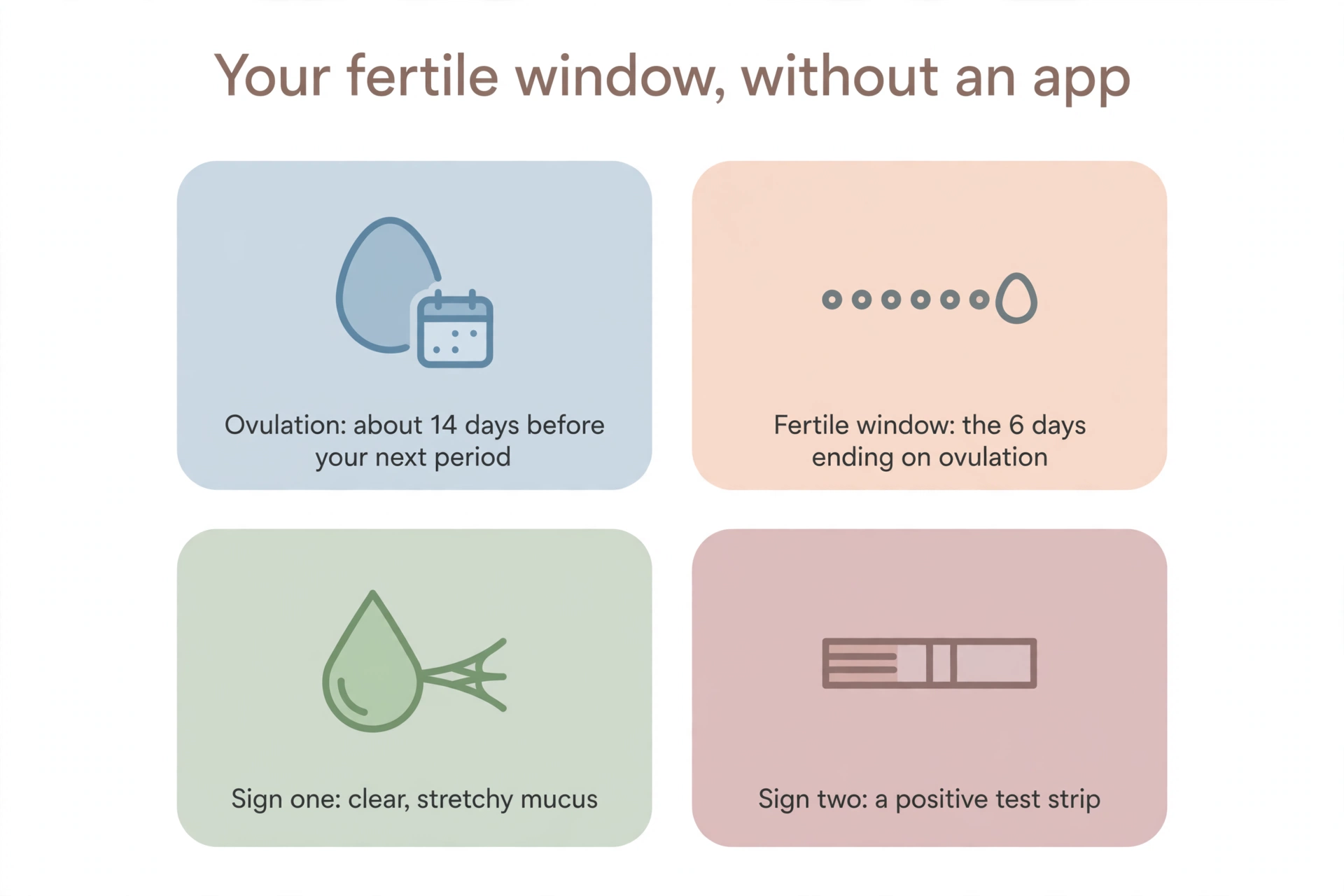
Your fertile window is the six days ending on ovulation day: the five days before ovulation plus ovulation itself. That is because sperm can survive up to five days inside the body, while the egg only lives for about 12 to 24 hours after it is released. So the days that matter are the ones before ovulation, not after it.
Ovulation usually happens about 14 days before your next period starts — not 14 days after your last one began. For a regular 28-day cycle, that works out to around day 14. For a 32-day cycle, ovulation is closer to day 18. For a 26-day cycle, it is closer to day 12. Count backwards from the next period, not forwards from the last one.
The most reliable signs that ovulation is approaching are clear, stretchy cervical mucus — often described as looking like raw egg white — and a positive ovulation test, which detects the hormone surge that comes 24 to 36 hours before the egg is released. Body temperature only confirms ovulation after it has happened, so it cannot predict the window on its own. Use at least two signs together, and the picture gets much clearer.
Why "day 14" gets so many people in trouble
The day-14 rule comes from the average cycle: 28 days long, ovulation in the middle. It is tidy, easy to remember, and wrong for a large share of real cycles.
Ask a group of women how long their cycles are and you will hear 25, 29, 31, 34 — and the same woman may vary by three or four days from one month to the next. Stress, illness, travel, a bad month's sleep: all of them can push ovulation later, and a late ovulation pushes the whole fertile window with it. An app that assumes day 14 will still say day 14. Your body will not have read the memo.
This is the exact trap people describe online. One woman tracked for months with an app, timed everything to its predicted window, and only got a positive ovulation test five days after the app said she had already ovulated. Another found her window kept moving by a week whenever she was stressed at work — the app averaged it away, and she was left wondering why nothing was working. The pattern is always the same: the app was confident, the body was different, and nobody questioned the app until months had passed.
The fix is simple and it is free: work from your own cycle length. If your cycles are fairly regular, the calendar maths below will put you within a day or two. If they are irregular, the calendar alone is not enough — and that is where the body signs in the next section earn their keep.
The calendar method: counting backwards
Start with two dates you can find in any calendar app, a diary, or the back of an envelope: the first day of your last period, and how many days your cycles usually last. Cycle length is counted from the first day of one period to the first day of the next.
Step one: take your usual cycle length and subtract 14. That gives the day ovulation usually falls on, counting from the first day of your period. A 28-day cycle gives day 14. A 32-day cycle gives day 18. A 26-day cycle gives day 12.
Step two: count five days back from that ovulation day. That six-day stretch is your fertile window.
Here it is worked out for three different cycle lengths, all starting on 1 January:
- 26-day cycle — ovulation day 12 (12 January). Fertile window: 7–12 January.
- 28-day cycle — ovulation day 14 (14 January). Fertile window: 9–14 January.
- 32-day cycle — ovulation day 18 (18 January). Fertile window: 13–18 January.
Look at the spread: the same start date, three different windows, a full week apart from the shortest to the longest. The woman with the 32-day cycle whose app insists on day 14 is being told her fertile days end on day 14 — four days before she has even ovulated.
Two warnings before you trust the calendar alone. First, use your own average, not 28: if your last six cycles were 30, 31, 29, 32, 30 and 31 days, your average is about 30, so ovulation lands around day 16. Second, the calendar predicts the usual pattern — it cannot see this month's delay. If you were ill or stressed this month, ovulation may come later than the calendar says, and the body signs below are how you catch that.
The body signs that actually predict ovulation
The calendar gives you the expected week. These signs narrow it to the day — and they are the reason the calendar alone is never the whole method.
Cervical mucus. This is the sign most fertility specialists rate highest, and it costs nothing to check. In the days before ovulation, mucus becomes clear, slippery and stretchy — the classic description is raw egg white, and it stretches between
your fingers instead of breaking. That texture is not a coincidence: it helps sperm travel and survive. When you see it, you are in the fertile window, usually one to three days before ovulation. After ovulation it dries up quickly and turns cloudy and sticky. If you notice only one sign, make it this.one.
Ovulation predictor kits. The cheap urine test strips sold in any pharmacy detect the LH surge — the sharp rise in luteinising hormone that triggers ovulation, usually 24 to 36 hours later. A positive strip means ovulation is coming, not that it has happened, which is exactly what you want for timing. Start testing a few days before your expected window (two days before the calendar's first fertile day is a good rule) and test once a day, at roughly the same time. A faint line does not count — the test line needs to be as dark as, or darker than, the control line.
Basal body temperature. Your temperature at rest rises by roughly 0.3 to 0.5°C after ovulation, and stays up until your next period. That makes it an excellent confirmation that ovulation happened — and a poor predictor, because by the time you see the rise, the fertile window is already closing. Used on its own, it tells you what happened yesterday. Used alongside mucus and test strips, it confirms the pattern over a few months and shows you whether you are actually ovulating at all. It needs consistency to be useful: same time every morning, before getting up, after at least three hours of sleep.
The middle-of-cycle ache. Some people feel a dull ache or sharp twinge on one side of the lower belly around ovulation — sometimes called mittelschmerz. It is a useful extra clue if you get it, but it is not reliable enough to stand alone: plenty of people never feel it, and a stomach ache on day 16 is not proof of anything by itself.
Putting it together: a simple no-app routine
You do not need to track everything, every day. A routine that takes two minutes a day in the fertile week is enough.
First, keep a one-line note for each cycle: the date your period started, and the date the next one starts. After three or four cycles you have your real average cycle length, which is worth more than any app's default.
Second, a few days before your calendar window opens, start watching the mucus and testing with strips once a day. The day you see egg-white mucus or a positive strip, you are in the window.
Third, check your temperature if you want confirmation — not to plan the week, but to look back over the month and see whether the rise came when you expected it. After a few months, the pattern teaches you your own cycle better than any prediction ever could.
And keep the expectation honest: even with perfect timing, a healthy couple in their twenties and early thirties has roughly a one-in-four to one-in-five chance of conceiving in any given month. That is normal biology, not a sign that something is wrong. Timing improves the odds; it does not guarantee a result in a single month.
The quicker way: check it with a calculator
If the backwards counting feels fiddly, you do not have to do it on paper. The free calculators on CalcZila include one built for exactly this job: put in the first day of your last period and your usual cycle length, and an ovulation calculator that works out your fertile window from your last period will give you the window and the expected ovulation day — and it counts backwards from your next period, the way the maths actually works, instead of assuming day 14. Use its dates as the starting point, then let the mucus and test strips confirm the real day this month. If the calculator's window and your body signs disagree by more than a couple of days, trust the body signs — they are reporting on this cycle, and the calculator is reporting on your average one.
The same kind of date arithmetic comes up everywhere once you start counting days properly — it is the same problem as counting down the days to a big event, and the same off-by-one mistakes that catch people there catch people here. Getting the counting right is half the job.
When the calendar stops working
The method above assumes fairly regular cycles. There are situations where it breaks down, and recognising them early saves months of frustration.
Irregular cycles. If your cycles swing by more than about a week — say 26 days one month and 38 the next — the calendar prediction is little better than a guess. The body signs become the whole method: mucus and test strips tell you the window when it actually arrives, even if the calendar had no idea it was coming. Keep noting the dates anyway; the pattern of irregularity itself is useful information to bring to a doctor.
Very long or very short cycles. Cycles consistently longer than 35 days or shorter than 21 days are worth mentioning to a clinician, especially if you are trying to conceive. They can be entirely normal for some people, and they can also be the first sign of something that affects ovulation. A single odd month means nothing; a pattern across several months is worth a conversation.
After stopping hormonal contraception. Periods can take a few months to settle into a rhythm after stopping the pill or having a coil removed, and ovulation may return before the first proper period. The calendar will be unreliable until the pattern settles — the body signs work from the first cycle, because they report on what is happening now.
When to seek advice. The usual guidance is to talk to a doctor after 12 months of trying if you are under 35, or after 6 months if you are 35 or over — sooner if your cycles are very irregular, very painful, or absent altogether. Bring your cycle notes: three months of dates, mucus observations and test results are far more useful to a clinician than "the app said day 14."

Frequently asked questions
Can I get pregnant outside the fertile window?
The window is the only time conception is possible, because the egg lives for about a day after ovulation. But the window starts earlier than most people think: sperm surviving up to five days means sex five days before ovulation can still lead to a pregnancy. Sex after ovulation, once the egg has gone, cannot.
My app says day 14 but my cycle is 33 days. Which is right?
Your cycle. Ovulation comes about 14 days before your next period, so a 33-day cycle puts ovulation around day 19, and the fertile window around days 14 to 19. The app's day 14 is five days early — it is only the first day of your real window, not the peak of it.
I got a positive ovulation test — how soon should we try?
Within the next day or so. The LH surge means ovulation is likely 24 to 36 hours away, and the egg only lives about a day once it arrives. A positive test today means the next two days are the ones that matter most.
Does a temperature rise mean I'm fertile right now?
No — it means you were. The rise comes after ovulation, so by the time you see it, the window is closing or closed. Temperature confirms ovulation happened; it does not predict it. Use it to learn your pattern, not to time the month.
Can I use this method to avoid pregnancy?
That is a different job, and a riskier one: the calendar-and-signs approach used for avoiding pregnancy (fertility awareness) needs proper training, strict daily tracking, and accepts that no method is foolproof — sperm surviving five days and ovulation shifting by a few days are exactly the margins that cause surprises. This article is about finding the fertile days, not avoiding them, and avoiding pregnancy needs advice from a clinician, not a blog post.
The bit worth remembering
Your fertile window is the six days ending on ovulation, and ovulation comes about 14 days before your next period — not 14 days after your last one. Count backwards from your own cycle length, confirm the week with the signs your body gives you — clear, stretchy mucus and a positive test strip — and remember that an app's confident date is only ever an average. Your cycle is the real data.