
You've known your age your whole life. Then you open a job application and find a box that says "Age as on 01/01/2026: ___ years ___ months ___ days" — and suddenly you're staring at it like a trick question. Three empty boxes, a date that isn't today, and small print warning that wrong details mean rejection.
This is where job forums fill up every recruitment season: "Born 23 August 1999 — am I 26 or 27 for this post?" "The cut-off is 1st January but my birthday is in February, what do I write?" Government job notices love an age limit, but the same problem turns up on visa forms, school enrolment, insurance applications and sports registrations. The maths isn't hard; the form is just asking a slightly different question — and the obvious ways of answering it produce wrong numbers.
Short answer
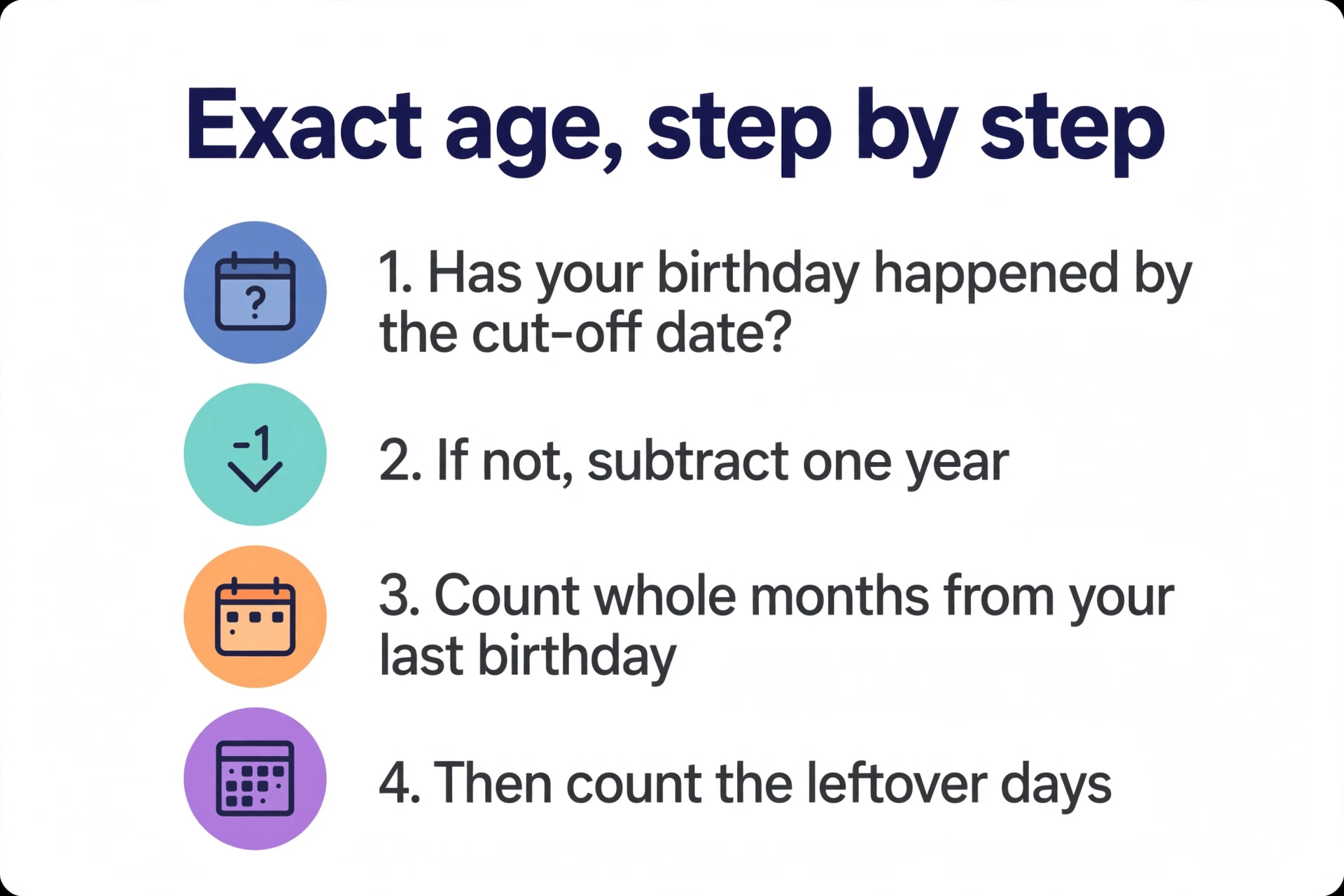
Your age on any given date is the number of full years you have completed by that date. One question decides the years: has your birthday happened yet in the year of the reference date? If not, you are one year younger than simple year-subtraction suggests. For the full figure in years, months and days, count whole months forward from your last birthday, then the leftover days — or work backwards with the borrowing method below. Mental maths breaks down because months don't all have the same number of days, and once a February gets involved, most careful counting slips by a day or two.
Why forms ask for age "as on" a date
Age limits only work if everyone is measured on the same day. If a post is open to candidates aged 21 to 28, the employer needs one fixed date to judge that against — otherwise eligibility would depend on which morning you happened to press submit. So the notice names a reference date, and it is rarely today: often the application deadline, the first of January, or the first day of the recruitment year.
The limits are applied literally, too. If the maximum is 28 "as on" the cut-off date and you turned 29 the day before it, you're out — even if you were 28 for the month you spent preparing. Turning 18 the week after the deadline doesn't count either, if the minimum is 18 on the deadline. There is no rounding and usually no appeal, which is why those three little boxes deserve more than a guess.
The birthday rule
Everything hangs on whether your birthday has passed by the reference date. Take someone born on 14 March 2000:
• 1 January 2026: age 25
• 10 March 2026: age 25
• 13 March 2026: age 25
• 14 March 2026: age 26
• 31 December 2026: age 26
Notice the jump between the 13th and the 14th: same person, same week, but the answer flips overnight. If your birthday falls just after the reference date, you are the younger age for the whole process — "basically 26" carries no weight. It's the same off-by-one trap that catches people counting down the days to a big event.
Working out years, months and days by hand
The reliable paper method is borrowing. Write the reference date over your birth date, lined up by year, month and day, and work right to left.
Worked example: born 23 August 1999; the form wants your age as on 9 February 2026.
• Days first: 9 minus 23 won't go, so borrow one month. The month you're borrowing from is January — the month just before February — and January has 31 days, so the 9 becomes 40. 40 minus 23 gives 17 days.
• Months next: February lent one, so it now counts as month 1. 1 minus 8 won't go either, so borrow a year: the 1 becomes 13. 13 minus 8 gives 5 months.
• Years last: 2026 lent one, so it's 2025. 2025 minus 1999 gives 26 years.
Result: 26 years, 5 months, 17 days. Check it forwards: your 26th birthday was 23 August 2025, five whole months from there lands on 23 January 2026, and 23 January to 9 February is 17 days. It matches.
One warning: you borrow the length of the month before the reference month. Borrowing into March uses February's days — 28, or 29 in a leap year.

Where the quick methods go wrong
Subtracting the years. 2026 minus 1999 gives 27, and plenty of people write 27 and move on. But the August-born candidate above is 26 in February — this year's birthday is still months away. Year-subtraction overstates the age of everyone whose birthday falls after the reference date.
Dividing your days by 365. Count that person's total days — 9,667 by 9 February 2026 — and divide by 365: you get 26 years with 177 days left over. The true figure past the 26th birthday is 170 days. The seven phantom days are the leap days lived through along the way (2000, 2004, all the way to 2024); dividing by 365 pretends they don't exist.
Trusting a spreadsheet formula blindly. Excel's DATEDIF is popular for this, and its "MD" unit — the one returning the leftover days — is known to give wrong results in some cases; Microsoft itself flags it. Formulas that divide by 365.25 or treat every month as 30 days drift in their own ways.
Borrowing from the wrong month. Using 30 days for January, or 31 for February, is the classic slip — and it produces an answer that looks reasonable while being a day out.
The quicker way: check it with a calculator
Once you understand the borrowing, you don't have to perform it under pressure. On the full shelf of free calculators at CalcZila there is one built for exactly this job: put your birth date and the form's reference date into an age calculator that shows the years, months and days side by side, and it does the borrowing for you — just make sure the "age as on" date you enter is the one printed on your form, not today's date. If the result and your rough count disagree, the borrowed month's length is the first place to look.
The same kind of tool covers the other arithmetic that piles up during an application — counting total days of work experience between two dates, say — handy when one form asks your age and the next asks how many days you've been employed. And if an officer ever queries a figure, "I counted the completed years to the cut-off date" is an answer; "the website said so" isn't.
Age in days, weeks and hours
Some records — medical files, some insurance and employment paperwork, most baby-age tracking — want a single count of days. The person above had lived 9,667 days by 9 February 2026: exactly 1,381 weeks, or 232,008 hours. Seven of those days were 29 Februaries, which is why multiplying your age in years by 365 always undercounts. If a form wants days, count the days; don't estimate them from the years.

Edge cases that trip people up
Born on 29 February. In an ordinary year there is no 29 February for your birthday to land on, and systems differ: some treat 28 February as your birthday, others 1 March. There is no universal rule — it varies by country, organisation and form. Read the application's own instructions, and whatever date your official documents use, use that same date on every form.
Born close to midnight. A baby born at 11:55 pm and one born at 12:05 am are ten minutes apart and a full day apart on paper. Add a time zone — a birth overseas, registered back home — and the recorded date can shift again. For form purposes none of it matters: the date on the official record is your date of birth, full stop.
Corrected or mismatched documents. If a birth certificate was corrected, or an adoption produced new paperwork, the date on the current official document is the one to use — everywhere. Most age-related rejections aren't about eligibility; they're about two documents telling different stories.
Frequently asked questions
The form says age "as on 31 December" but I'm filling it in during November. Which date do I use?
The printed reference date — always. Work out your age as it will stand on 31 December. Note what that does to January birthdays: turn 27 in mid-January and you are still 26 as on 31 December.
My birthday is next week. Can I round up?
No. Forms count completed years only: 25 years and 51 weeks is still 25 until the birthday itself arrives. Rounding up is one of the fastest ways to get an application rejected for incorrect details.
My birth certificate and passport show different dates. Which one goes on the form?
Use the date on the document the form is checked against — for most job applications, the birth certificate or national ID the employer will verify. Then get the other document corrected. Mixing dates between forms is what gets flagged.
How do I write years, months and days in the boxes?
Exactly as calculated, in that order: 26 years, 5 months, 17 days. Some forms compress it to something like 26Y 5M 17D. Fill separate boxes separately, and check you haven't swapped the months and days.
How does this work for school admission cut-offs?
The same rule, applied to your child: the stated age — often five or six — must be completed by the cut-off date, commonly 1 September or 31 December. Born a day late and the child starts the following year instead; there's rarely any discretion.
The bit worth remembering
On a form, your age is not a fact about you — it's a fact about you on one particular date. Count the years you've completed by that date, let the birthday rule decide whether to subtract one, and borrow carefully if you need the months and days too.