The notification lands at 2:41pm. Delivered. You were home at 2:41pm — on the sofa, ten feet from the front door — and nobody knocked, nobody rang, and there's no parcel on the step. You refresh the tracking page. It doesn't change its mind: Delivered, 2:41pm, left in a safe place. Whose safe place? Not yours, apparently.
If there's a delivery photo, that's often the strangest part: people open it to find a doorstep they've never seen — different door, different mat, sometimes a house on a different street entirely. Others get no photo — just "delivered," and an evening of arguing with a chatbot ahead. The annoying truth is that most of these parcels aren't stolen: they're mis-scanned, mis-dropped, or sitting somewhere daft nearby. What matters is knowing what to do first — and who's actually responsible. It probably isn't who you think.
Short answer
Most parcels marked "delivered" that aren't at your door turn up within 24 to 48 hours — scanned early, left with a neighbour, held at a depot, or tucked somewhere unchecked. Give it one working day before escalating, unless the contents were urgent or perishable.
And here's the part most people get backwards: if the parcel never shows up, it's the seller's problem, not yours. In the UK and US alike, the retailer's responsibility generally runs until the goods are actually in your hands — and the courier works for them, not you. Work the checklist below; if nothing surfaces, go to the retailer, in writing.
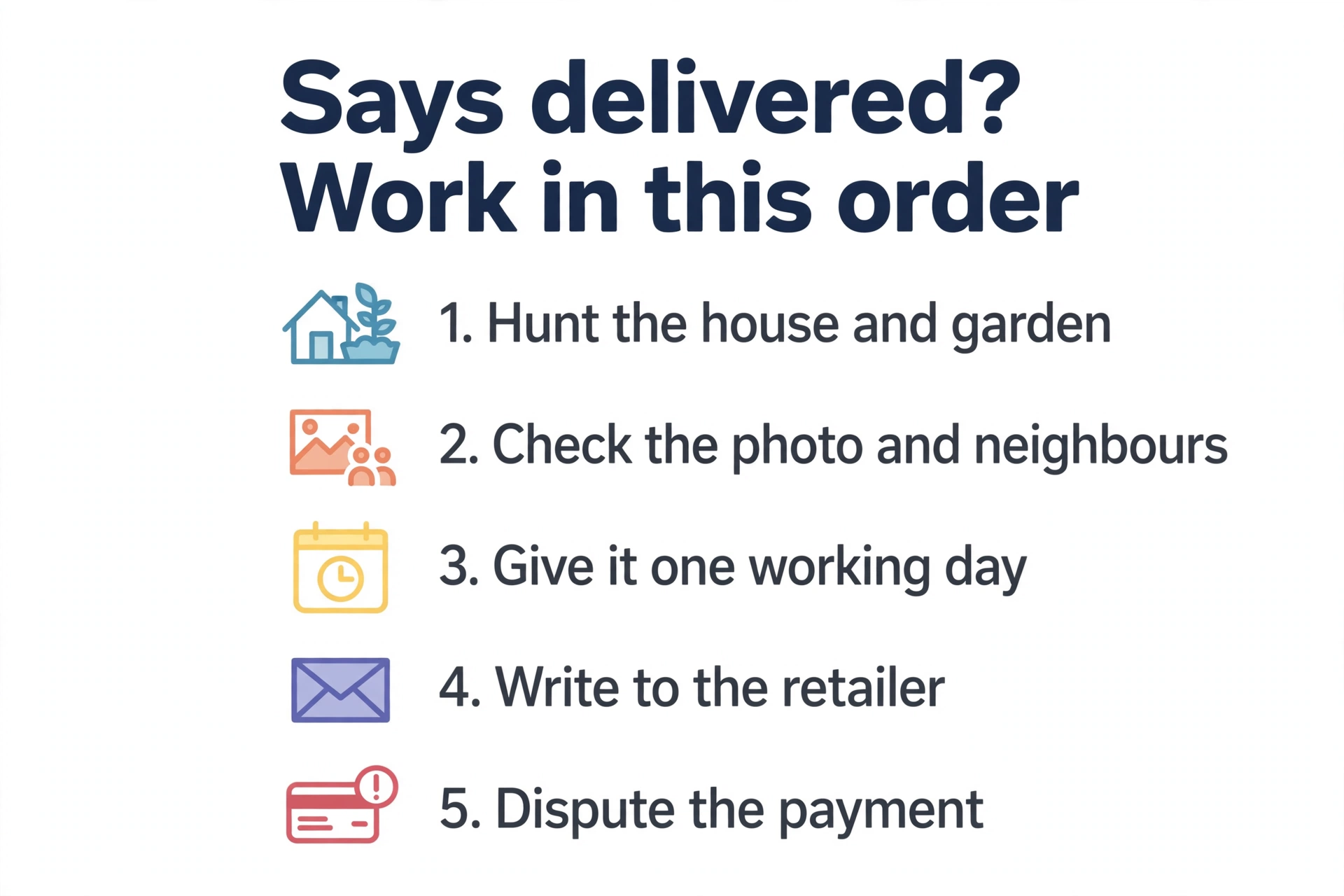
First, the 15-minute hunt
Before you contact anyone, spend fifteen minutes on the search. A surprising share of "missing" parcels turn up on this lap of the house — and you'll want to say you did it when you write to the retailer later.
Walk the whole perimeter: behind the bins, under the side gate, inside the porch or meter box, behind plant pots, the garage. Look wherever someone in a hurry would call "out of the rain" — under a bench, beneath a hedge, once memorably inside a barbecue cover. Check any safe place you nominated when ordering.
Then study the delivery photo, if there is one. Zoom in — is that mat yours? People regularly spot a neighbour's porch in it, or a house two doors down. Knock on both neighbours, and the house opposite if your numbering is odd; drivers misread numbers constantly. Two quieter checks: verify the address on the order confirmation character by character — an old address or missing flat number explains a lot — and ask everyone else in the house, because parcels get brought in, put "somewhere safe," and forgotten by lunchtime constantly.
Why tracking says delivered when it isn't
The delivered scan isn't always a scan of your parcel at your door. Sometimes it's made at the depot before the van has left, to keep the day's numbers right. Sometimes the driver's handheld drops its GPS pin on the wrong house, recording a delivery at number 42 that physically happened at number 24. Sometimes the parcel went to the same street name in the next postcode over. And sometimes a driver under time pressure marks it delivered intending to come back — and it turns up the next day as if nothing happened.
That last one is why the waiting matters: a scan appearing a day before the parcel itself is reported constantly, and nothing hurries it. One working day is a fair allowance; after that, treat it as missing.
- No photo, no parcel, you were home: most likely scanned early, or marked delivered ahead of the drop — wait one working day, then contact the retailer
- Photo shows a doorstep that isn't yours: delivered to the wrong house nearby — match the photo's door to houses on your street and knock
- Signed for, by a name you don't know: left with a neighbour whose name is on the signature — ask around with the name
- Still nothing after 48 hours: genuinely lost, mis-sorted, or taken — contact the retailer in writing and ask for a refund or replacement
- Marketplace order from an overseas seller: a long carrier chain with tracking handed between firms — use the marketplace's own resolution centre, not the overseas carrier
- High-value item, vanished completely: theft, or a serious mis-delivery — retailer first; report likely theft to the police non-emergency line
Who to contact, and in what order
Start with the retailer you paid. The tracking page pushes you toward the courier, but your contract is with the seller, theirs with the courier; chasing the courier is their job. Deal only with the courier and you risk the loop: courier says "talk to the seller," seller says "the courier delivered it," and weeks slide by.
Keep it short and factual, in writing where you can — email or the site's own messaging. Order number. Date and time of the delivered scan. "I do not have the goods." Say you've checked with neighbours and around the property, and ask for a replacement or a refund. That's it: no accusations, no proving a negative.
Contact the courier in parallel, as fact-finding rather than the main event. Couriers can check the scan's GPS location and sometimes ask the driver where the parcel went — which occasionally shakes it loose from the wrong porch. Bought through Amazon or eBay? Use their resolution routes too; both tend to side with buyers where tracking is all the seller has.
Your rights in plain English
In the UK, under the Consumer Rights Act 2015, goods stay at the trader's risk until they come into your physical possession — or the possession of someone you specifically nominated. A parcel left with a neighbour you never named, or dropped on a doorstep while you were out, generally hasn't reached your possession. So a retailer who says "the courier marked it delivered, nothing we can do" is not the end of it. Citizens Advice's guide to problems with a delivery covers the steps, including what to put in your message.
In the US, the FTC's Mail, Internet, or Telephone Order Merchandise Rule likewise puts the obligation on the seller to ship what you ordered and answer for it — and when a seller insists a package was delivered, most shoppers' practical protection is the payment route: the card dispute process, covered next. Either way: a scan is evidence, not proof the goods reached you.
Retailers deal with this daily; the decent ones reship or refund once it's in writing. The ones who push you toward the courier are hoping you'll give up and absorb it.
If it still goes nowhere
Give the retailer a reasonable chance — a few working days and one follow-up — and screenshot everything as you go: the "delivered" tracking page, the photo, your messages. Tracking pages get overwritten; screenshots don't.
If the seller won't refund or replace, escalate through the payment. In the UK, credit-card purchases over £100 generally let you claim against the card provider too, under Section 75; for debit cards or under £100, ask your bank about chargeback. In the US, dispute the charge with your card issuer, or use PayPal's resolution process. Slow routes — but they work, and they concentrate a retailer's mind wonderfully.
One separate case: if the evidence points to actual theft — photo shows the parcel on your step at 3pm, gone by 4pm — report it to the police non-emergency number and get a reference. It rarely recovers the parcel, but it strengthens a refund claim, and those reports flag theft hotspots.
Stop it happening again
Once bitten, most people fix this with one setting change. Add delivery instructions to your accounts — a safe place that's dry and hidden from the street, not "by the door." Better still, take the doorstep out of it: a lockable parcel box costs less than most things left outside, and a locker, collection point, or your workplace removes the guesswork for anything valuable.
Order often? A video doorbell earns its keep less as a deterrent than as evidence — a timestamped clip of an empty doorstep at 2:41pm ends the "but we delivered it" argument fast. And if every ring of that bell also sets the dog off inside the house, that is its own fixable problem — our guide to why dogs go crazy at the doorbell covers the other side of the front door.
And check the address on every confirmation: a remarkable number of missing parcels sit, perfectly delivered, at the address you lived at two years ago.
Frequently asked questions
How long should I wait before reporting it?
One full working day after the delivered scan, once you've done the 15-minute hunt. Perishable, medication, or needed for a deadline? Skip the wait; contact the retailer the same day.
The courier says the GPS shows my address. Now what?
Ask — through the retailer if needed — for the scan record and driver notes, and point out what doesn't fit: no photo, no knock, you were home. GPS pins drift by a house or two; a pin near your address isn't a parcel in your hands, and retailers know it.
Refund or replacement — is it my choice?
Generally, yes: if the goods haven't reached you, ask for a replacement or your money back. A replacement is usually fastest if you still want the item; otherwise, insisting on a refund is reasonable.
What if it was a gift someone sent me?
The contract is between the sender and the seller, so the sender has to raise it — slightly awkward, but a quick message with the tracking screenshot is all it takes. Ordered a gift to your own address? It's your claim as normal.
It says signed for, but that's not my signature
Say exactly that, in writing. Signatures are often a driver's squiggle, or the name of whoever opened a door nearby. A signature that isn't yours, from someone you didn't nominate, doesn't count as the goods reaching you.
The bit worth remembering
A "delivered" scan is a claim, not a fact. Do the quarter-hour hunt, give it a day, then write to the retailer — politely, factually — and let the people who chose the courier chase the courier. The parcel usually turns up. When it doesn't, the responsibility was never really yours.