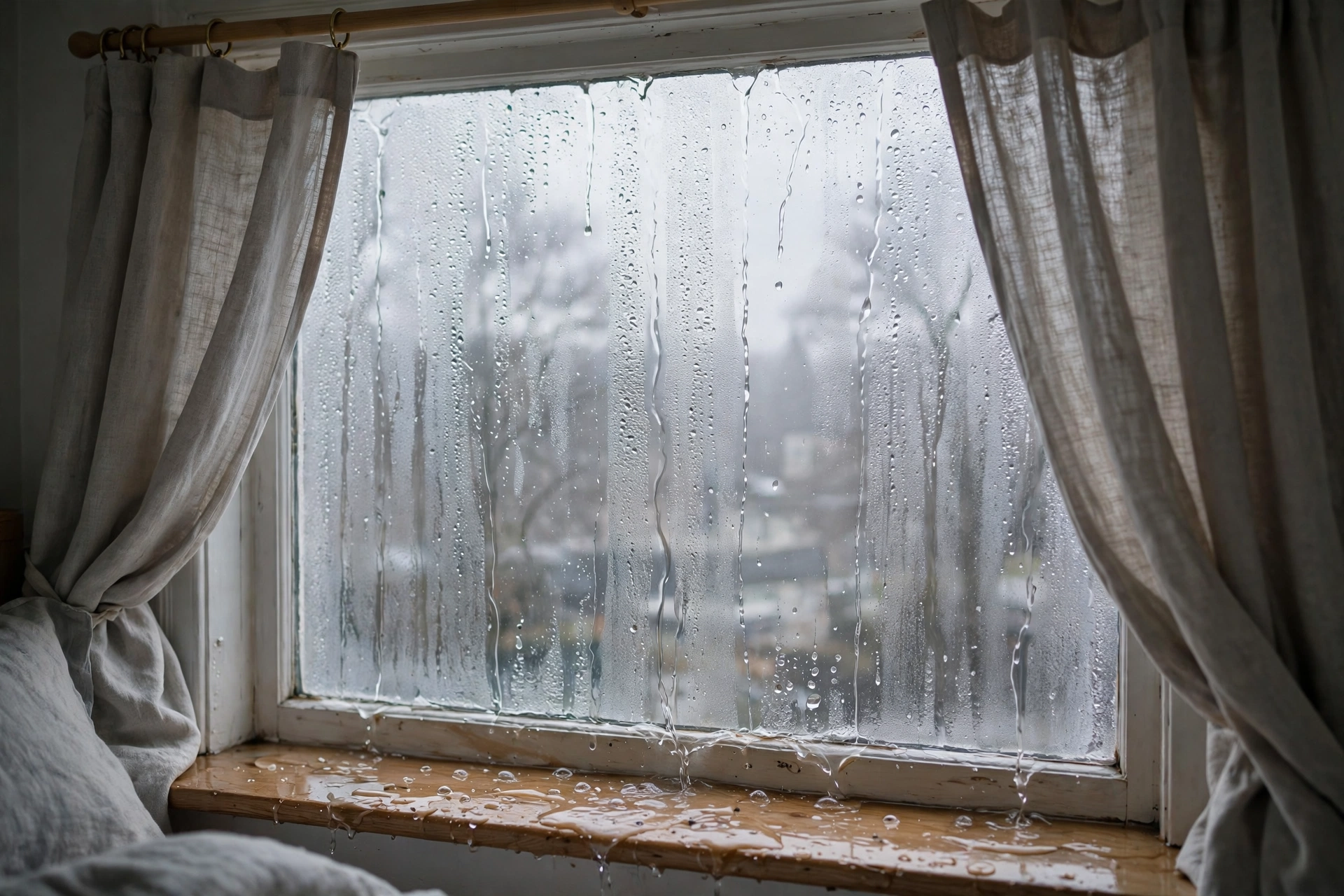
Every winter morning it starts the same way. You pull the curtains back and the bedroom window is already soaked — not misted, streaming, water running down the glass and pooling along the sill. The towel that lives on the radiator gets another outing. By February there's a grey fuzz in the corners of the frame that wipes off black, and the paint at the bottom is starting to bubble.
Renters post this scene every year, usually along with their landlord's advice: just open a window. In January. In a bedroom that's already the coldest room in the flat. It's just missing the other two-thirds of the picture: how much water you're putting into the air, and how cold the glass gets overnight.
Short answer
Warm air can hold a lot of moisture, and your home produces plenty of it — from breathing, cooking, showers and drying laundry. On a winter night the windowpane is the coldest surface in the room. When the glass drops below the dew point of the air touching it, that invisible vapour turns back into liquid water on the glass. The fix is a balance of three things, in roughly this order of cost: make less moisture, let more of it out, and keep the glass warmer. New windows are the expensive last step, not the first one.
Where all that water actually comes from
It surprises people how much water ordinary living generates. One official guide puts a typical household at up to around 100 litres of moisture a week. The sources won't surprise you:
- Breathing. A sleeping adult breathes out moisture all night — roughly a mug or two's worth per person. Two people behind a closed door for eight hours is a real share of what's on the glass at 7am
- Showers and baths. A hot shower fills a small bathroom with steam in minutes, and a chunk of it — around a litre or so across a shower and drying off — ends up in the air if the fan and window don't take it out first.
- Cooking. Boiling pasta, simmering a stew, a kettle boiled five times a day — a lidless pan lets off a noticeable amount over an evening.
- Drying clothes indoors. The big one. A load of washing holds a lot of water — commonly put at around 2 litres or more per load — and every drop goes into the room air as it dries.
Inside the glass, outside the glass, or between the panes
Before you change a single habit, check where the water actually is — the three possibilities have completely different fixes.
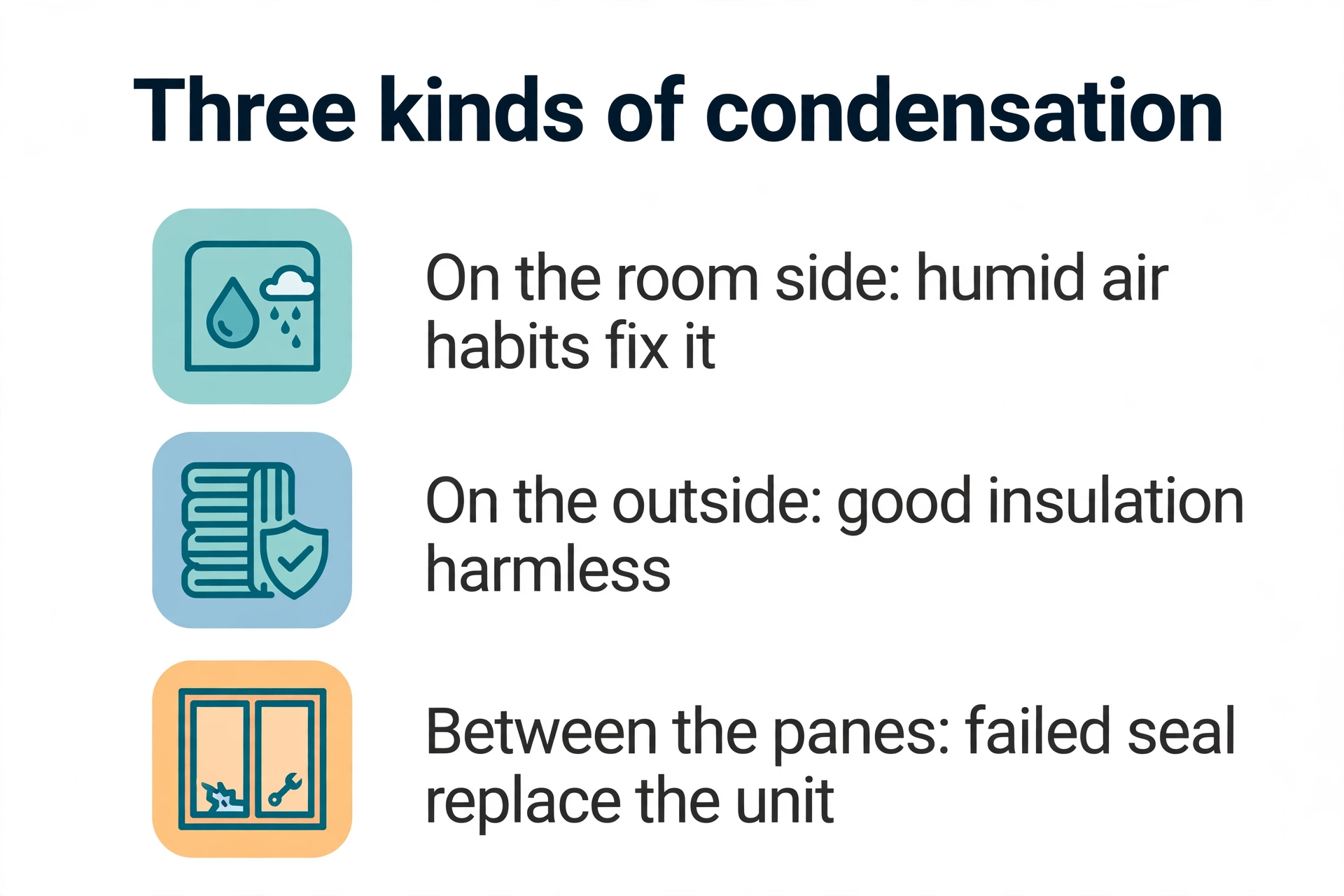
- On the room side of the glass — what it means: your indoor air is humid and the glass is its coldest meeting point; what fixes it: less moisture made, more let out, steadier heating
- On the outside of the glass — what it means: the outer pane is cold because the window is keeping your heat in — usually a sign it's insulating well; what fixes it: nothing — it's harmless and clears as the morning warms up
- Between the two panes — what it means: the seal around the double-glazed unit has failed and let moist air inside; what fixes it: replacing the sealed unit — no habit or gadget fixes this one
Room-side water is the normal winter kind, and it's what the rest of this article is about. Outside water is good news — it forms on efficient windows because the outer pane stays cold, like dew on a car roof. Between the panes is the only genuine fault, and people waste whole winters ventilating a room for a problem ventilation can't touch.
The daily habits that make the biggest difference
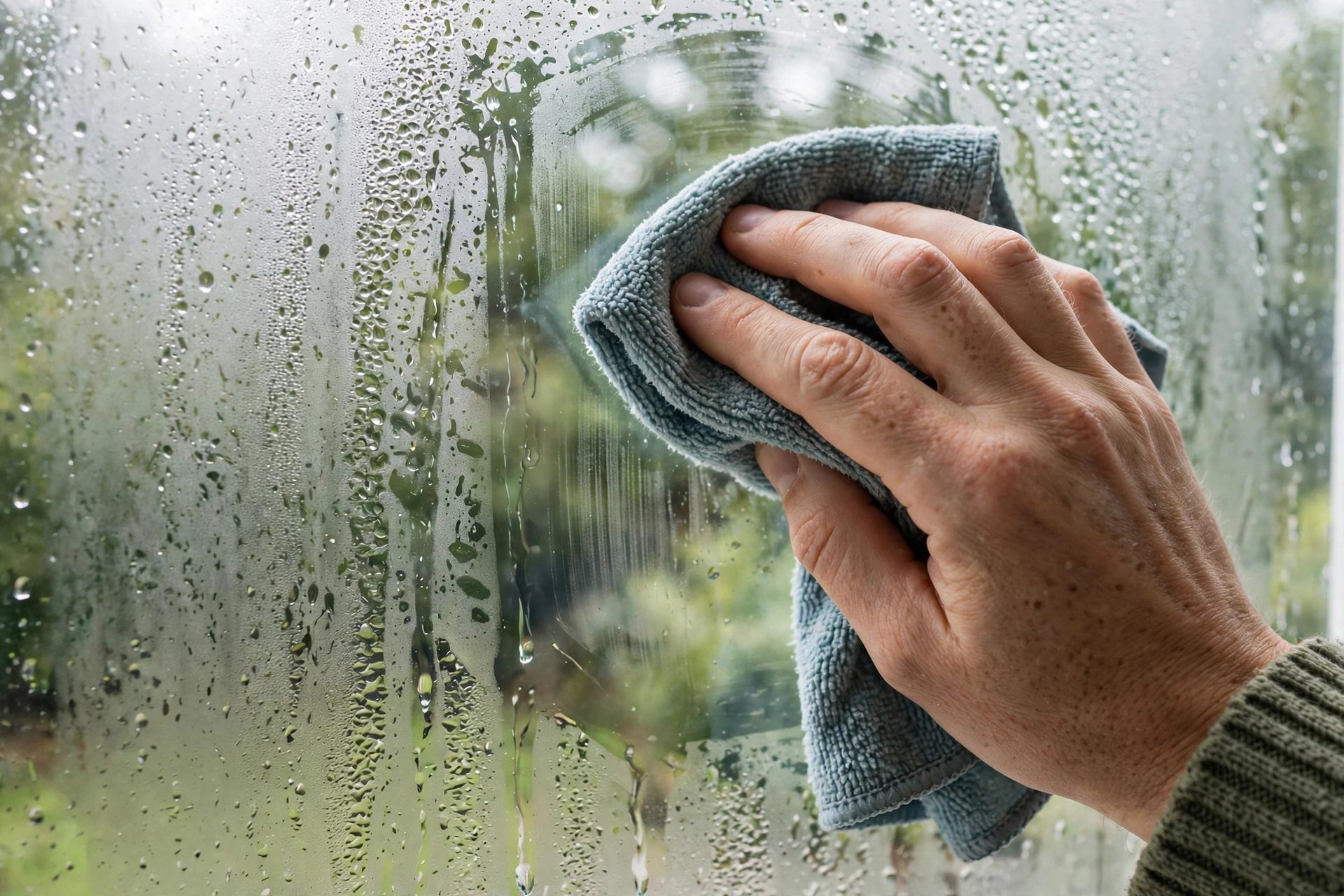
Wipe the glass down in the morning. Window vac or an old towel — either works. Water sitting in the bottom seal all day is what rots frames and feeds mould, so getting it off matters.
Lids on pans, extractor on. Cook with lids where you can, run the cooker hood, and crack the kitchen window while things boil and for a bit afterwards.
Keep the bathroom's moisture in the bathroom. Door shut while you shower, fan on, and leave it running — or the window open — for a while after you've finished, rather than flinging the door open and sharing the steam with the rest of the home.
Don't dry laundry in the bedroom. If clothes have to dry indoors, put the rack in one room, shut the door, and open that window or run a dehumidifier in there, rather than loading the worst room with the most water.
Leave the trickle vents open. Those little slots at the top of the frame are there for this. Commonly found taped over in draughty rooms, they let out a steady trickle of moist air without the chill of an open window.
Heat low and steady rather than in one hot blast. A room warmed for two hours then left to go cold has cold walls and glass for most of the day, and cold surfaces are where moisture lands. It's the same steady-heating point that comes up in our guide to why an electricity bill is suddenly so high — there it's about cost, here it's about keeping surfaces above the dew point for longer.
Pull furniture a few centimetres off the coldest walls. Air that can't circulate behind a wardrobe on an outside wall leaves that patch cold and damp — which is why mould appears behind furniture first.
Ventilation without freezing the house
The landlord's "just open a window" has a better version. Instead of a window cracked an inch all day — a slow leak of cold air that chills the room and its surfaces — throw the windows wide for five to ten minutes. The room's air swaps almost completely, but the walls and furniture hold their warmth, so it feels normal again within minutes of closing them. Two or three of these blasts a day — after showers, after cooking, before bed — shift more moisture than a permanent crack.
A small dehumidifier in the worst room is the other tool that earns its keep. People are often startled by the first full tank: it can pull a litre or two a day out of a damp bedroom, and emptying that bucket daily shows you how much water was in the air. Running costs are usually modest — most home units draw a couple of hundred watts, though your tariff decides the exact figure. Run it with the door closed where you're drying laundry, or in the bedroom overnight, and judge it after a week of mornings.

When condensation is a warning sign
Black mould in the corners of frames and ceilings is the main one. Mould thrives where condensation sits day after day, and living with a lot of it isn't good for anyone's breathing, particularly children and people with asthma. Small patches can usually be cleaned carefully — gloves on, room ventilated, a proper mould cleaner, not a dry scrub, which spreads spores. But if it keeps coming back in the same place despite decent habits, it's not a cleaning problem any more. The Energy Saving Trust's guide to fixing damp and condensation lays out the common causes and fixes, and in a rental it's worth remembering the split: your habits are your responsibility, but broken extractor fans, failed window units and missing insulation are the landlord's side of the bargain.
Condensation in just one room, when the rest of the home is dry, points to a local source — an ensuite shower, laundry dried in there, an unvented tumble dryer. Water appearing on the walls themselves, in patches that don't match any window, suggests cold spots where insulation is missing or has slipped — thermal bridging, in the jargon. That's a building fix, not a behaviour fix, and worth getting looked at properly.
Frequently asked questions
Are new windows supposed to stop it?
They help, because a better unit keeps the inner pane warmer, so it sits above the dew point more of the time. But they don't remove any moisture from your air. If the air is wet enough, the water lands on the next coldest surface instead — a wall corner, or the wall behind the wardrobe.
Does a bowl of salt or cat litter on the sill work?
Marginally, at best. Both absorb a little moisture from the air nearby, and both saturate quickly. Against a household producing litres a day, a bowl of salt is a gesture — it won't hurt, but it won't fix anything either.
Should I leave a window open all night in winter?
For most homes, no — you lose heat for hours and chill the very surfaces you're trying to keep warm. Trickle vents plus a wide-open blast before bed and when you get up does the same job better.
Why is it only the bedroom windows?
Because bedrooms get the perfect combination: two people breathing out moisture for eight hours, a door closed against the rest of the home, and the heating turned down overnight so the glass gets cold. The living room gets heat and open doors all evening. The bedroom just sits there, collecting.
Dehumidifier or window vac — which should I buy first?
They do different jobs. The vac removes water that has already landed, which protects your frames and sills, and costs nothing to run. The dehumidifier stops the water landing in the first place. If your windows drip but the room dries by midday, start with the vac. If the room never really feels dry, the dehumidifier is the one that changes things.
The bit worth remembering
The window is the messenger, not the cause. The water on it was in your air — from showers, cooking, washing and breathing — and it landed on the glass because the glass was cold. Give that moisture a way out, keep the surfaces a little warmer, and mornings get drier within days. The one exception is water trapped between the panes: that's a failed unit, and the only version of this problem where the window itself is to blame.