
You are halfway through a shower, shampoo running into your eyes, when you hear it through the wall: the toilet refilling in the next room. Two seconds later, the water turns on you.
In some houses it goes arctic. In others — the version nobody jokes about for long — it goes scalding hot, hot enough to make you jump out of the spray. Plenty of people grew up with a parent who thought flushing mid-shower was the funniest prank in the world; plenty more have lived in rented flats with an iron-clad rule: no washing machine while anyone is showering.
Both versions come from the same fault: shower and toilet share one pipe, and the toilet is greedier. Which way yours swings depends on which side of the mixer loses the fight.
Short answer
The toilet cistern refills from the cold supply, fast, with its valve wide open. If your shower shares that cold pipe — in most houses it does — the refill steals cold pressure and flow for the thirty seconds the cistern takes to fill. Your mixer doesn't know; it just keeps blending whatever arrives, so the mix swings.
If the cold side is robbed, the mix swings hot. If the hot side is the weak one — a long run from the heater, a tankless heater that can't respond — it swings cold. Either way, the lasting fix is a valve that compensates: pressure-balancing or, better, thermostatic. The cheap fixes mostly work by slowing the toilet's refill so it stops stealing.
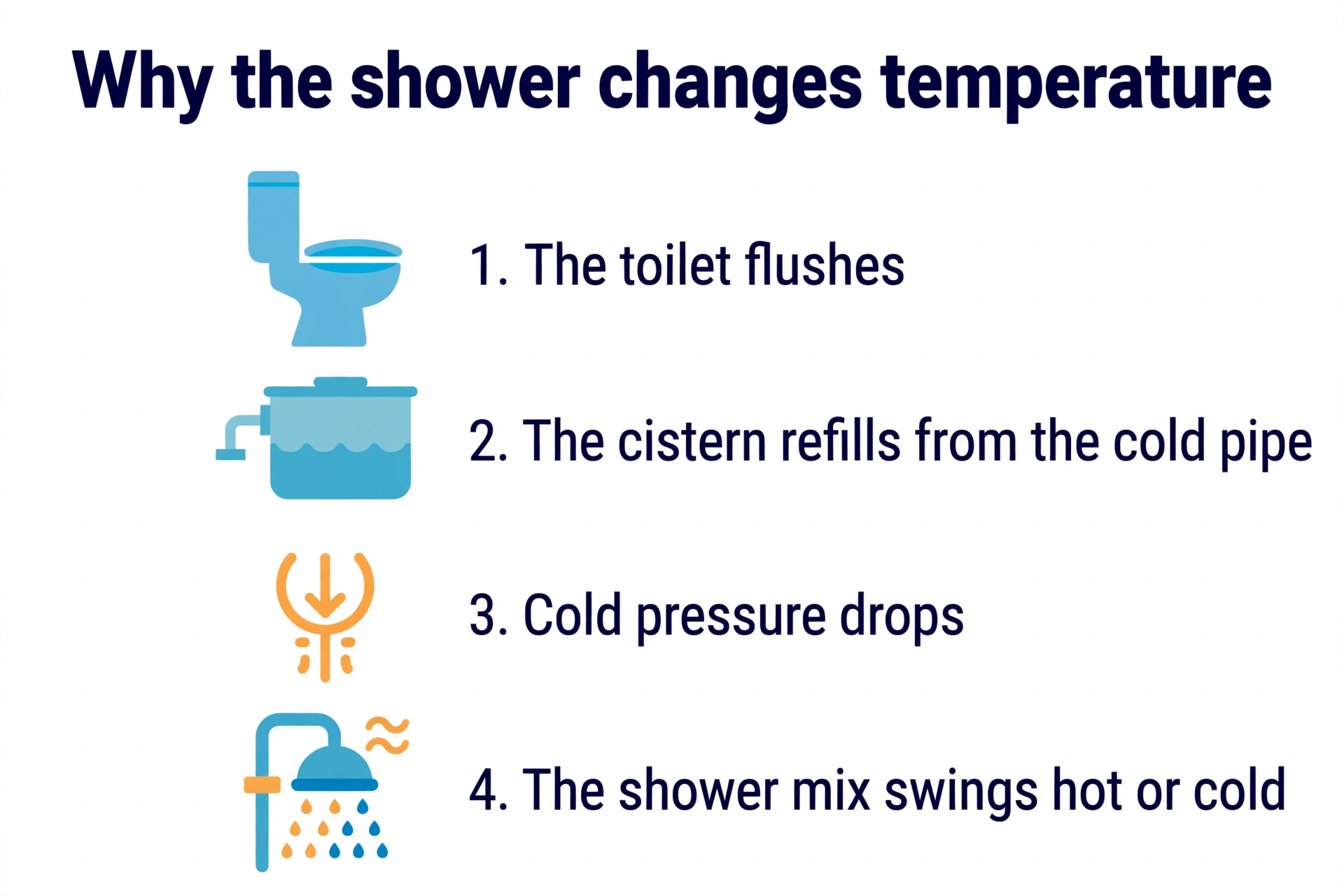
What is actually happening in the pipes
Mains water arrives through a single pipe, then branches to the kitchen tap, the basin, the toilet cistern and the cold side of your shower — everything in the bathroom hangs off the same branch.
With nothing else running, the mixer blends hot and cold in the proportion you set. The moment the toilet flushes, its cistern refills through a valve that opens fully and takes a big, sudden gulp. While it does, pressure in the shared pipe drops and less cold reaches the shower. The hot, travelling its own run from the boiler, keeps coming as usual — so the blend tips hot.
Older houses suffer worst: galvanised steel pipes, common before the 1970s, fur up inside with scale and rust until a half-inch bore might effectively be a quarter-inch, and water forced through a passage that narrow loses far more pressure per extra demand than in clean copper or plastic.
A tankless, on-demand heater adds a wrinkle: it only fires when it senses enough flow and responds slowly when demand changes, so on a long hot run the hot side can sag — and the shower swings cold instead.
Cold blast or scald? Why houses differ
A basic mixer is a simple, stupid device: it has no idea what temperature it's producing. It just opens two doors — hot and cold — by the amounts you set, and whatever comes through lands on your head.
When the toilet robs the cold side, that door is still open the same amount, but far less water gets through it. The hot door is unaffected, so the blend is proportionally much hotter. This is the classic scenario, and the dangerous one: a surge of near-boiler-temperature water can genuinely burn, and burns children and older people fastest — thinner skin, slower reactions.
The cold blast happens when the hot side is the weak link: a long pipe run from the heater, or its supply drawn down, so the hot flow drops more than the cold. Startling, but not a safety problem.
• Partly close the toilet's fill valve, or fit a slower one — cost: a few pounds/dollars, or free; difficulty: easy, ten minutes; how well it works: good — a slow refill steals far less
• The warn-the-house rule (no flushing during showers) — cost: free; difficulty: easy; how well it works: works until someone forgets
• Pressure-balancing shower valve — cost: roughly a hundred or two, plus fitting; difficulty: plumber for most; how well it works: very good against swings either way
• Thermostatic shower mixer — cost: a few hundred, plus fitting; difficulty: plumber; how well it works: best valve fix — holds a set temperature
• Dedicated supply runs or repiping — cost: thousands, and mess; difficulty: plumber, days; how well it works: solves it at the root, rarely worth it alone
The five-minute test
Run the shower at your normal temperature, have a helper flush the toilet, and take notes — on your phone, not on your skin.
Note which way it swings, how bad it is, and how long it takes to recover — a few seconds of mild change is a healthy system coping; a full minute of scalding is not. Then check whether it's only the toilet: start the washing machine on a fill cycle, which makes a similar sudden demand (and if yours also shakes and wanders while it works, that is a separate fault we have covered in why a washing machine shakes and walks across the floor), and try the kitchen tap too. And note whether the temperature ever drifts with no other water running at all — that points at the shower's own cartridge or a clogged inlet filter, a much cheaper repair.
Finally, check pressure generally. If every tap is feeble all the time, you have a low-pressure supply problem no shower valve will fully cure. If pressure is strong everywhere except mid-shower during a flush, it's a mixing problem — very fixable.
Cheap fixes first
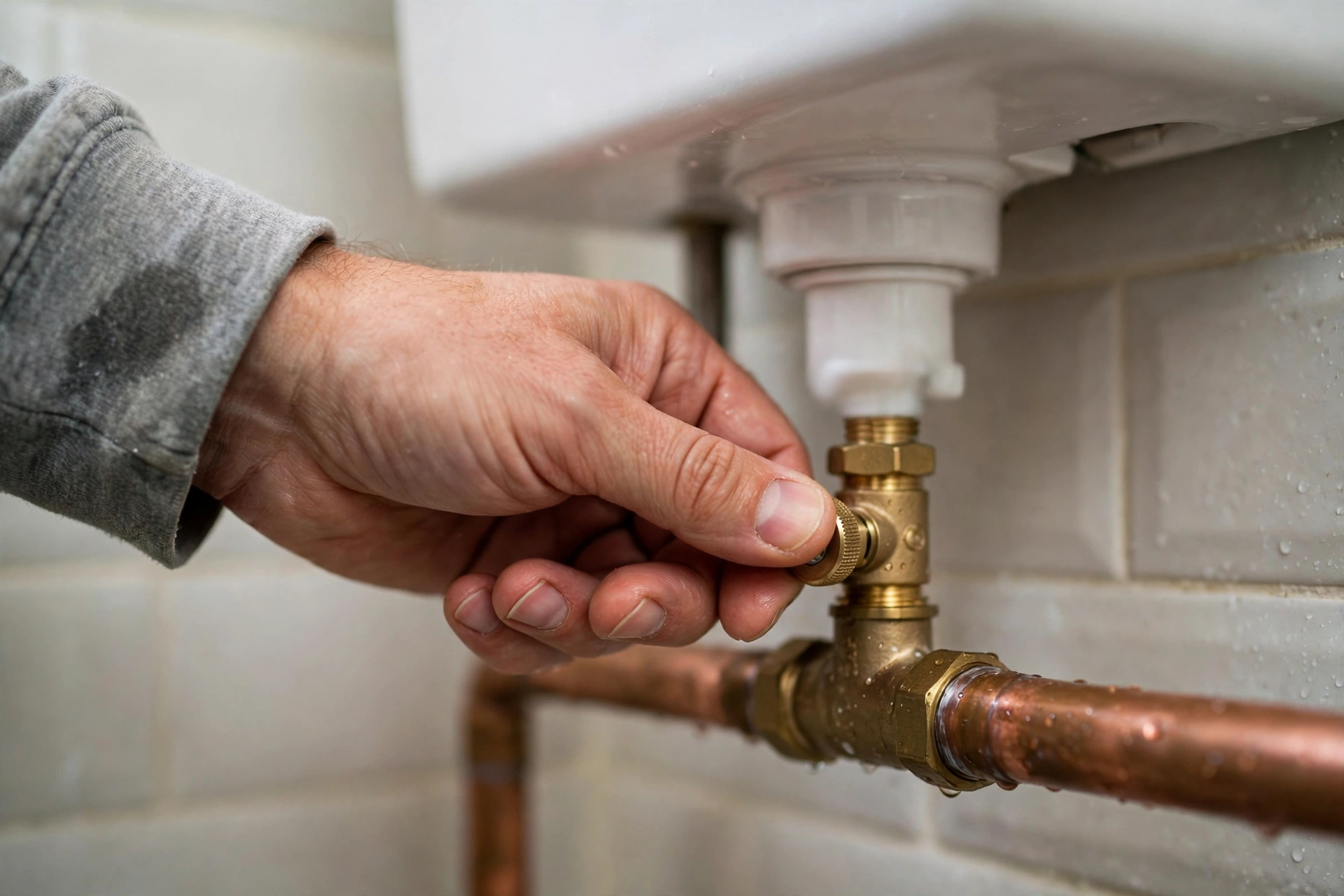
Start with the toilet, because it's the thief. Under or beside most cisterns there's a small isolation valve — sometimes called an angle stop — on the pipe feeding it. Turn it partly closed. The cistern takes a minute to refill instead of thirty seconds, but gently instead of in one gulp, and the pressure drop shrinks dramatically. Nobody has ever minded a slow-refilling toilet. If there's no valve, or it's seized, an adjustable replacement fill valve costs very little and fits in fifteen minutes.
The free fix is staggered water use and a house rule about flushing. It works precisely as long as everyone's memory does — which is not long.
And if your test showed drift with no other water running, clean or replace the shower cartridge. Cartridges clog with limescale and grit, the inlet filters fur up, and a tired cartridge can't respond properly — a cheap part, and a common cure.
The proper fix: balancing and thermostatic valves
If you want the problem gone rather than managed, the answer is the shower valve itself — and there are two kinds.
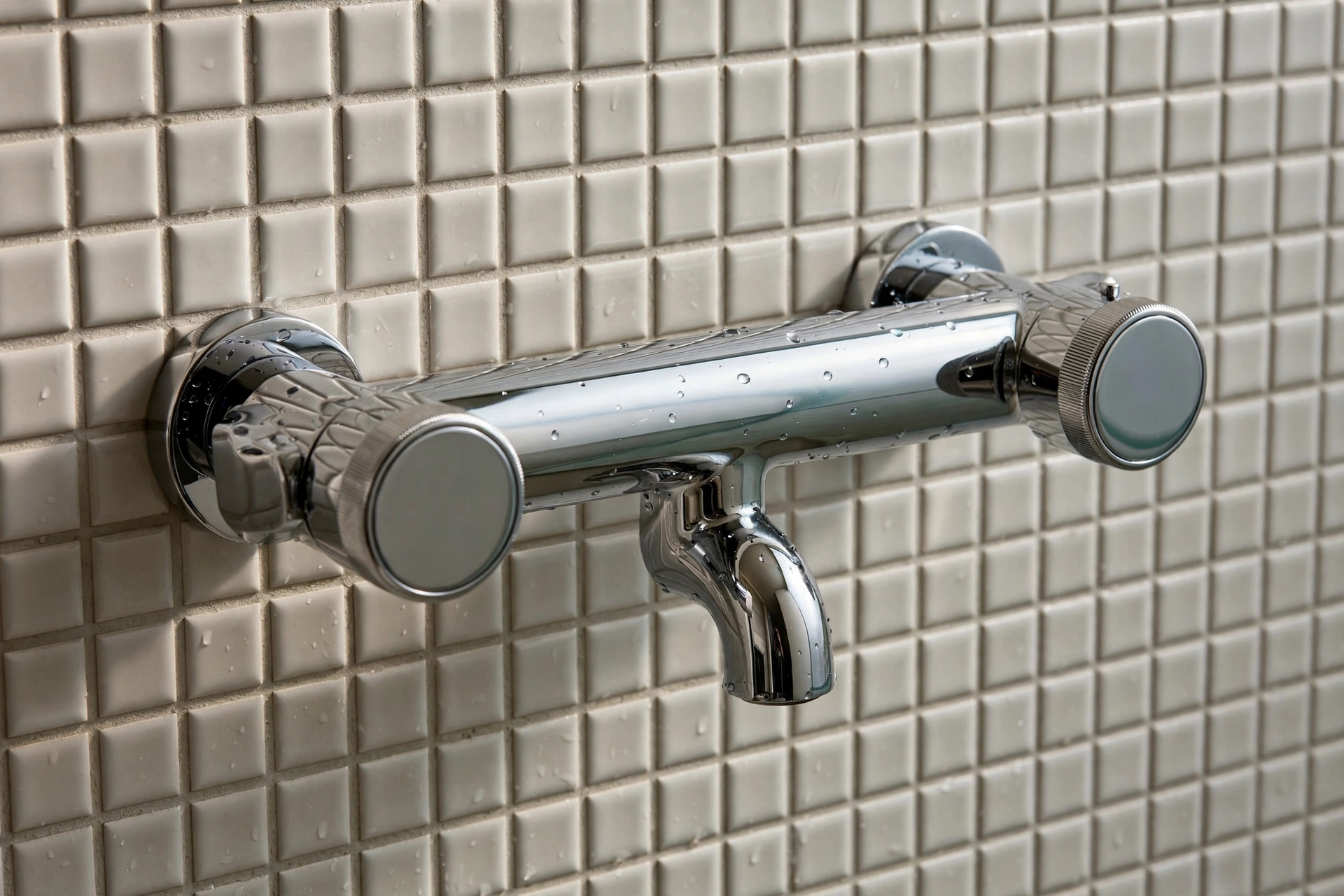
A pressure-balancing valve watches both supplies and evens them out. When the toilet steals cold pressure, it cuts the hot down by the same amount, so the ratio — and the temperature — stays put. Flow may dip slightly, but the temperature holds. It reacts to pressure only; it doesn't know the actual temperature.
A thermostatic mixer is cleverer: a temperature-sensitive element measures the blended water leaving the valve and adjusts the mix continuously to hold the exact temperature you dialled in. It is worth reading how a thermostatic mixing valve works before you shop — the mechanism explains why these cost more, and why they're standard in hospitals and care settings.
What does the plumber actually change? Usually the whole valve body or mixer unit — a straightforward swap on a bar mixer, though a built-in valve can mean opening the wall. Generally speaking, many building codes now require anti-scald protection of one of these two types in new and renovated showers; rules vary by place.
When to call a plumber instead
Some versions aren't a DIY afternoon. Call someone in if the pressure is low at every tap, all the time — that points at the incoming supply, a failing pressure regulator, or a furred-up stopcock. Call if the water runs discoloured after a flush, or if you hear hammering when taps shut off — water hammer alongside pressure swings is hard on joints and appliances.
And call sooner rather than later if your household includes small children or an elderly person and your shower swings hot — the margin for error is small, and a plumber-fitted thermostatic valve is cheap insurance compared with a scald.
Frequently asked questions
Is the scald actually dangerous, or just unpleasant?
It can be genuinely dangerous. Water at typical heater settings can burn skin in seconds — faster for children and older people. General safety guidance often suggests keeping stored hot water around 49°C / 120°F as a balance between scald risk and hygiene; treat that as background, not instruction.
Does this happen with electric showers?
Much less. An electric shower heats cold mains water itself instead of blending from a hot supply, so a flush shows up as a dip in flow rather than a temperature swing — though a big drop can still trip its safety cut-out. Flush-and-scald belongs to mixer showers.
Why does mine only do it in winter?
Incoming cold water is colder in winter, so your mixer needs more hot and less cold to reach the same temperature. The balance is more delicate, and a small theft of cold pressure tips it further.
Would a bigger water heater fix it?
No — this is a pressure problem, not a volume problem. A bigger tank gives you more hot water across the day, but the flush steals the same cold pressure and the mix still swings. Spend the money on the valve.
Do new-build homes have this problem too?
Rarely, and mostly mildly. Modern codes in many places call for anti-scald valves and better-sized pipework, and plastic pipe doesn't fur up like old galvanised steel. If a new house does it noticeably, raise it with the builder.
The bit worth remembering
Your shower isn't broken and your toilet isn't faulty. They're two appliances sharing one pipe, and the toilet takes its share too fast. Slow the toilet down, or fit a valve that refuses to let the temperature move — everything else is shouting through the wall.