You know the feeling. You set off with a number in your head — say, $600 for the long weekend — and you come home having spent $1,100, and you genuinely cannot say where the extra $500 went. There was no single disaster. The car didn't break down. Nobody got sick. It was just... everything. The fuel cost more than you guessed. Lunch was $40 because the only place off the exit was a sit-down restaurant. The "cheap" motel was $140 once taxes showed up. Someone wanted the scenic route, which added 90 miles. And the snacks — the snacks alone could have funded a small holiday.
Ask people who drive a lot and you hear the same story with different numbers. A couple who budgeted $800 for a week down the coast and spent $1,400. A group of friends who agreed to split everything evenly and ended the trip arguing about who owed what, because nobody wrote anything down. A family who planned the whole trip around cheap motels, then discovered at 9pm in a town with one motel that the room was $180 and non-negotiable. The trip itself was great. The money part left a sour taste that lasted longer than the holiday did.
The good news is that a road-trip budget is one of the few travel budgets you can actually get right in advance. Fuel is maths, not guesswork. Food is a decision you make before you leave, not something that happens to you at a service station. And the buffer — the bit everyone skips — is what turns a surprise into a shrug instead of a fight.
Short answer
A road-trip budget has five buckets: fuel, food, somewhere to sleep, tolls and entry fees, and fun — plus a buffer of 10 to 15 percent on top of the total. Fuel is the only bucket you can calculate almost exactly before you leave: miles divided by your car's real MPG, multiplied by the gas price along your route. Food is where most budgets die, because a family eating every meal at restaurants spends three to four times what a family with a cooler and one restaurant meal a day spends. Book your stays before you leave, write down every shared cost as it happens if you're splitting with others, and check the running total once a day — five minutes each evening — so you catch the leak while there's still trip left to save.
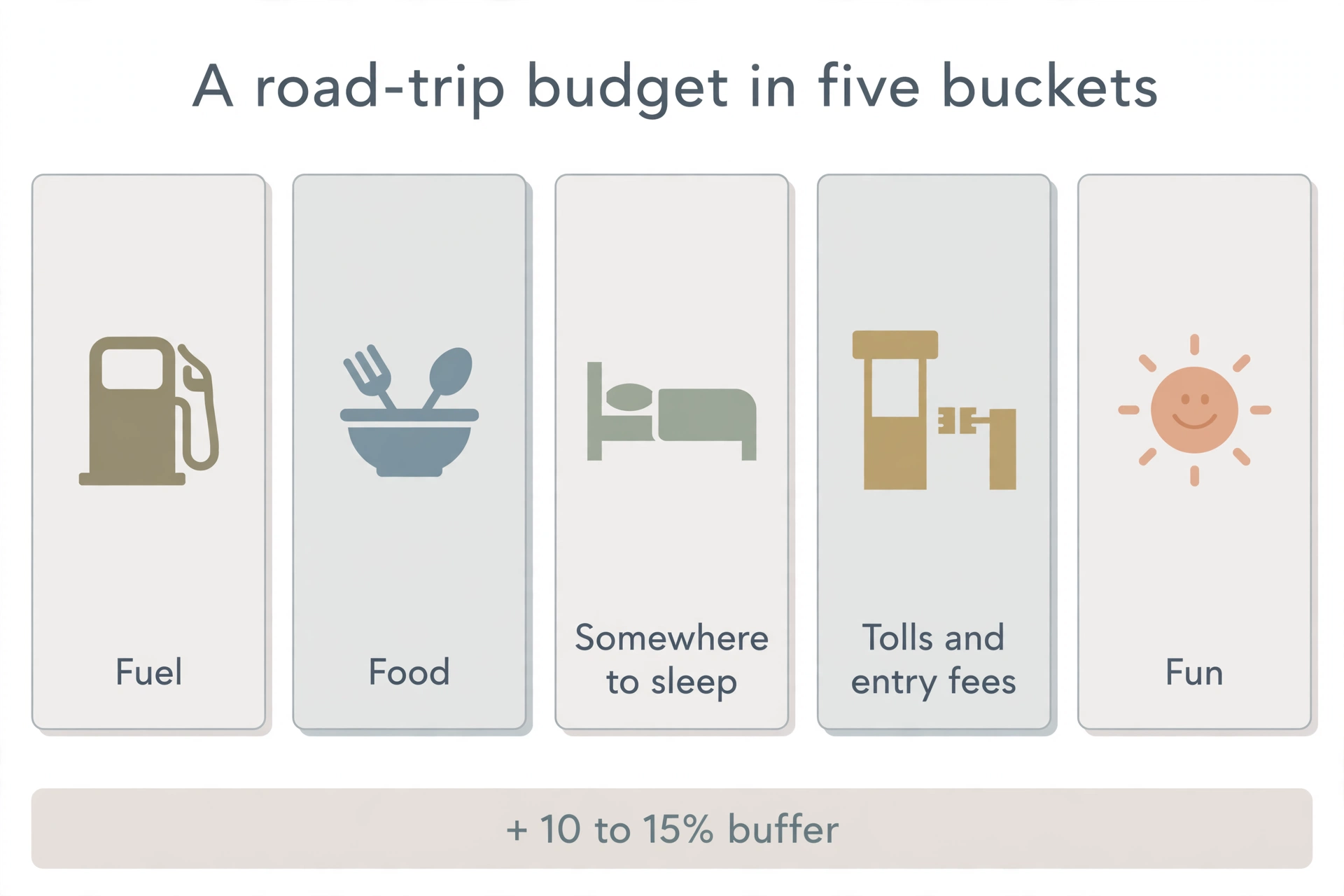
The five buckets, and what each one really costs
Before any numbers, get the shape right. Every road-trip dollar goes into one of these five places, and if you price all five you won't get ambushed.
1. Fuel. The most predictable cost on the whole trip — and the one people still get wrong, because they use the MPG on the advert instead of the MPG their car actually gets, and the gas price from home instead of the price where they're driving.
2. Food and drink. Usually the biggest bucket after fuel on a short trip, and the biggest bucket full stop on a long one. It is also the most controllable: the gap between "we ate out three times a day" and "we packed breakfast and lunch and ate out once" is hundreds of dollars over a week.
3. Somewhere to sleep. The most expensive single line on most trips, and the one with the nastiest surprises — resort fees, parking charges, taxes that only appear at checkout, and the walk-in price at 9pm being double the price you saw online that morning.
4. Tolls, parking and entry fees. The forgotten bucket. Nobody budgets for it, and then a $14 toll road, a $25 parking garage and a $30-per-car national park entry add up to real money by day three.
5. Fun. The stuff you actually went for: the boat hire, the museum, the mini-golf, the roadside attraction with the giant dinosaur. Price it honestly or it will price itself — at the gift shop, with your card.
Then the buffer sits on top of all five: 10 to 15 percent of the total, held for the flat tyre, the closed road that adds 60 miles, the night you need a hotel you didn't plan for. If you don't spend it, it's the start of the next trip. If you do need it, you're glad it was there.
- Fuel — $130. Priced as: 900 miles ÷ 28 MPG × $4.00/gal.
- Food — $210. Breakfasts from the cooler, one restaurant meal a day.
- Sleep (2 nights) — $260. Two $110 motels + taxes and fees.
- Tolls, parking, entry — $65. One toll road, two parking garages, one park entry.
- Fun — $90. One boat hire + one museum.
- Subtotal — $755.
- Buffer (15%) — $115. Held, not spent in advance.
- Trip total — $870. About $145 per person per day.
That table is the whole method in miniature: a real distance, a real MPG, a real gas price, and a meal plan decided before the car moves. Change any one number and the total moves with it — which is the point. A budget you can recalculate is a budget you can trust.
Fuel: the only number you can get exactly right
Start here, because it's the easiest win and it anchors everything else.
Take your total miles and divide by the MPG your car actually gets on the highway — not the combined figure in the brochure, and not the optimistic number the dashboard shows on a downhill stretch. If you don't know it, a full tank and a note of the miles will tell you in one trip. Then multiply by the gas price where you'll be driving, not where you live: prices can swing by a dollar a gallon between states, and the expensive states are usually the ones with the scenery. The U.S. Department of Energy's trip calculator will do the whole sum for your exact car and route, including current fuel prices: Find your trip's fuel cost. For the price along the way, AAA publishes average gas prices by state, updated daily: AAA gas prices.
Two things people forget. First, the scenic route costs fuel — a 60-mile detour is 60 miles of gas, food and time, and it is worth it when you choose it deliberately, not when you discover it afterwards. Second, running the air conditioning, a roof box, or a loaded trailer all eat into MPG. A roof box alone can cost you several miles per gallon on the highway, which over 900 miles is a full extra tank. If you're taking one, factor it in — or leave it behind and pack lighter.
Food: where road-trip budgets actually die
Nobody remembers the meal that broke the budget, because there wasn't one. There were twelve of them, each slightly more expensive than the last.
The trap is the exit. You're hungry, the kids are hungry, and the only options at this interchange are a fast-food place with a line out the door and a sit-down restaurant that charges $18 for a burger. You eat there because you're already stopped. Do that three times a day for four days and you've spent more on food than on fuel and the hotel combined — and you enjoyed about a third of those meals.
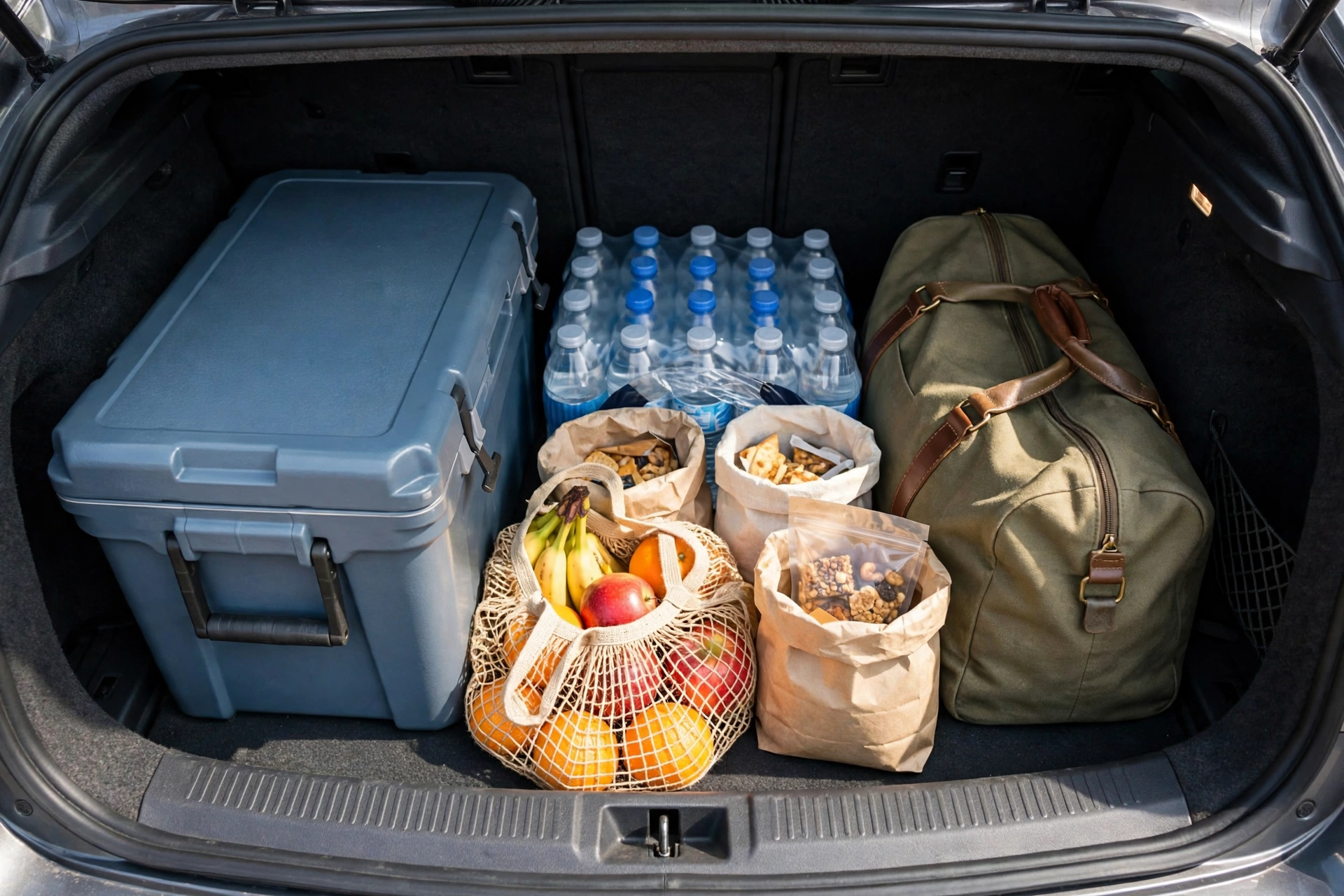
The fix is boring and it works: decide the food plan before you leave, the same way you decide the route. A cooler with sandwich supplies, fruit, water and snacks covers breakfast and lunch for two or three days for the price of one restaurant lunch. A grocery stop on the way out of town beats a service station every time — same sandwich, half the price. Then pick one restaurant meal a day, the one you'll actually enjoy, and make it the event rather than the default. Families who do this usually cut their food bill by half without feeling deprived at all; the kids remember the one good dinner, not the three petrol-station sandwiches they didn't have.
And water. Buy a case before you leave. A single bottle at a service station costs what a whole case costs at a supermarket, and on a hot day a family of four will go through several bottles before lunch.
Somewhere to sleep: book it before you need it
The most expensive mistake on a road trip is arriving somewhere at 9pm with no room booked. At that point you have no bargaining power, no alternatives, and the only motel in town knows it. The walk-in price is routinely double the advance price for the same room, and that is before the $25 parking charge and the taxes that only appear at checkout.
Book the nights before you leave, at least the first and last ones. If the middle of the trip is genuinely flexible, book refundable rooms — a free-cancellation booking costs nothing if you change your mind and saves you from the 9pm price. Read the total, not the headline: the room that says $89 and the room that says $110 can cost the same once one of them adds a resort fee, a parking fee and 14 percent tax. And check the parking situation before you book, not after you arrive: downtown hotels that charge $30 a night to park the car you drove there in are a special kind of insult, and a motel a mile out with free parking is often the cheaper stay even at the same room rate.
If you're camping or staying with friends for a night, say so in the budget — a $0 night is the best deal on the trip, and it frees up money for the night you do pay for.
Tolls, parking and entry fees: the forgotten 10 percent
Nobody puts tolls in the budget, and then a $14 toll road, a $25 parking garage and a $30 park entry quietly add up to $65 or more — the table above isn't exaggerating, and on some routes it's double that.
Check your route for tolls before you leave: most mapping apps will show the toll total if you ask, and a toll transponder or the exact change in the glovebox saves you the fine that comes with a missed toll. National parks charge per vehicle, not per person, and an annual pass pays for itself in about three visits — if the trip includes two or more parks, buy the pass at the first gate and stop paying at the rest. City parking is the same story: look up the garage price before you drive downtown, and remember that parking a little further out and walking ten minutes is usually $15 cheaper than parking underneath the thing you came to see.
Splitting costs without the awkwardness
Road trips with friends live or die on money, and it is almost never the amount — it is the vagueness. "We'll sort it out later" is how a great trip ends with someone quietly resenting the person who ordered the expensive dinner and never paid for fuel.
Agree the split before the car moves: everything shared gets split evenly, personal stuff is personal, and one person keeps the running list. Every time anyone pays for something shared — fuel, food, a night's stay — it goes in the list the same day, with the amount. Settle up every evening, or at the latest at the end of the trip, while everyone still remembers what happened. An app makes this painless, but a notes page works just as well; the tool matters less than the habit of writing it down the day it happens. The same fairness logic applies at home, by the way — splitting a trip's shared costs is the same problem as splitting a flat's bills, and the rules that keep roommates friendly keep road-trippers friendly too: How to split rent and bills fairly with roommates.
And keep a small shared kitty in cash for tolls and parking. The person driving should not have to fish for a card at every toll booth while everyone else watches the scenery.

Tracking it on the road: five minutes a night
A budget you never look at is a wish. The whole system is one habit: every evening, five minutes, one question — how much have we spent so far, and how much is left for the days ahead?
That is the moment you catch the leak. Food is running $30 a day over? Tomorrow is a cooler day. The hotel was $40 more than planned? The fun bucket shrinks a little, or you pick the free hike instead of the paid boat trip. Catching it on day two costs you a packed lunch. Catching it on the drive home costs you the argument about the credit card bill.
Two tricks that help. First, use one card for all trip spending — the statement is your tracker, and there's no guessing afterwards about what was trip and what was home. Second, keep the buffer visibly separate: if the buffer lives in the same pot as the spending money, it gets spent on snacks by day two. Decide in advance what the buffer is for — breakdowns, detours, a night you didn't plan — and leave it alone for everything else. If a delay does force an unplanned overnight stop, that is exactly what the buffer is for, and it helps to know how to handle the night itself: What to do when your flight is delayed overnight covers the same ground for the version of the problem that starts at an airport instead of on a highway.
Frequently asked questions
How much should I budget per day on a road trip?
For two people sharing a car and a room, a realistic range is $120 to $200 per person per day all-in, depending on where you sleep and eat. The table above works out to about $145 per person per day for a mid-range trip. Solo travellers pay more per person because the room and the fuel aren't shared; a family of four pays less per person for the same reason. Price your own trip from the five buckets rather than copying someone else's daily number — your route, your car and your appetite are the variables that matter.
What is the biggest hidden cost on a road trip?
Food, by a distance — not because any single meal is expensive, but because three restaurant meals a day for several days adds up faster than anything else on the trip. After food, it's the accommodation extras: taxes, resort fees and parking that don't appear in the headline room price. Both are avoidable with ten minutes of planning before you leave.
Should I use cash or card on a road trip?
Card for almost everything, cash for the small stuff. A single card for all trip spending makes the nightly check trivial. But keep some cash for tolls, small-town parking meters, farm stands and the places that still don't take cards — and keep the shared kitty separate from your own wallet so the split stays clean.
How big should the buffer be?
Ten to fifteen percent of the total, and more if the car is old, the route is remote, or the weather is uncertain. A new car on a well-travelled route can get away with 10 percent. An older car on mountain roads in winter wants 15 to 20. The buffer is not spending money with a different name — if you spend it on souvenirs on day one, it's gone when the tyre goes on day three.
Is it cheaper to fly or drive?
It depends on the distance and the number of people. For one person going a long way, flying is often cheaper once you count fuel, a night's stay and your time. For two or more people, driving usually wins, because the fuel and the room cost the same whether two people or four are in the car, while every extra flyer is another ticket. As a rough rule, under about 500 miles driving wins for a group; over that, do the sums for your exact trip before deciding.
The bit worth remembering
A road-trip budget isn't about being stingy — it's about deciding in advance where the money goes, so the trip is the thing you remember and not the bill. Price the fuel exactly, because you can. Decide the food plan before you leave, because that's where the money leaks. Book the bed before you need it, write down every shared cost the day it happens, and check the total for five minutes every evening. Do that, and the number you come home with will be close to the number you left with — and the extra $500 will be spent on the trip you actually wanted, not on the one that happened to you.