It is 2 a.m. The house is silent, and from the kitchen comes a buzz like the fridge has decided to power a small factory. You lie there listening. It stops. It starts again. In the morning, with the kettle on, it sounds perfectly normal, and you wonder if you imagined it.
You didn't. Almost every fridge owner has had this night. The machine has not changed after dark — your house has. Here is how to work out what the buzzing is, in the order a technician would check it.
Short answer
Usually the fridge is not louder at night — the house is quieter, so a sound that runs all day suddenly becomes the loudest thing in it. The buzz usually comes from one of three places: a fan, ice where it should not be, or the cabinet vibrating against something. Work through the checks below in order and you will normally find it in ten minutes, mostly without tools.
First, work out where the sound is coming from
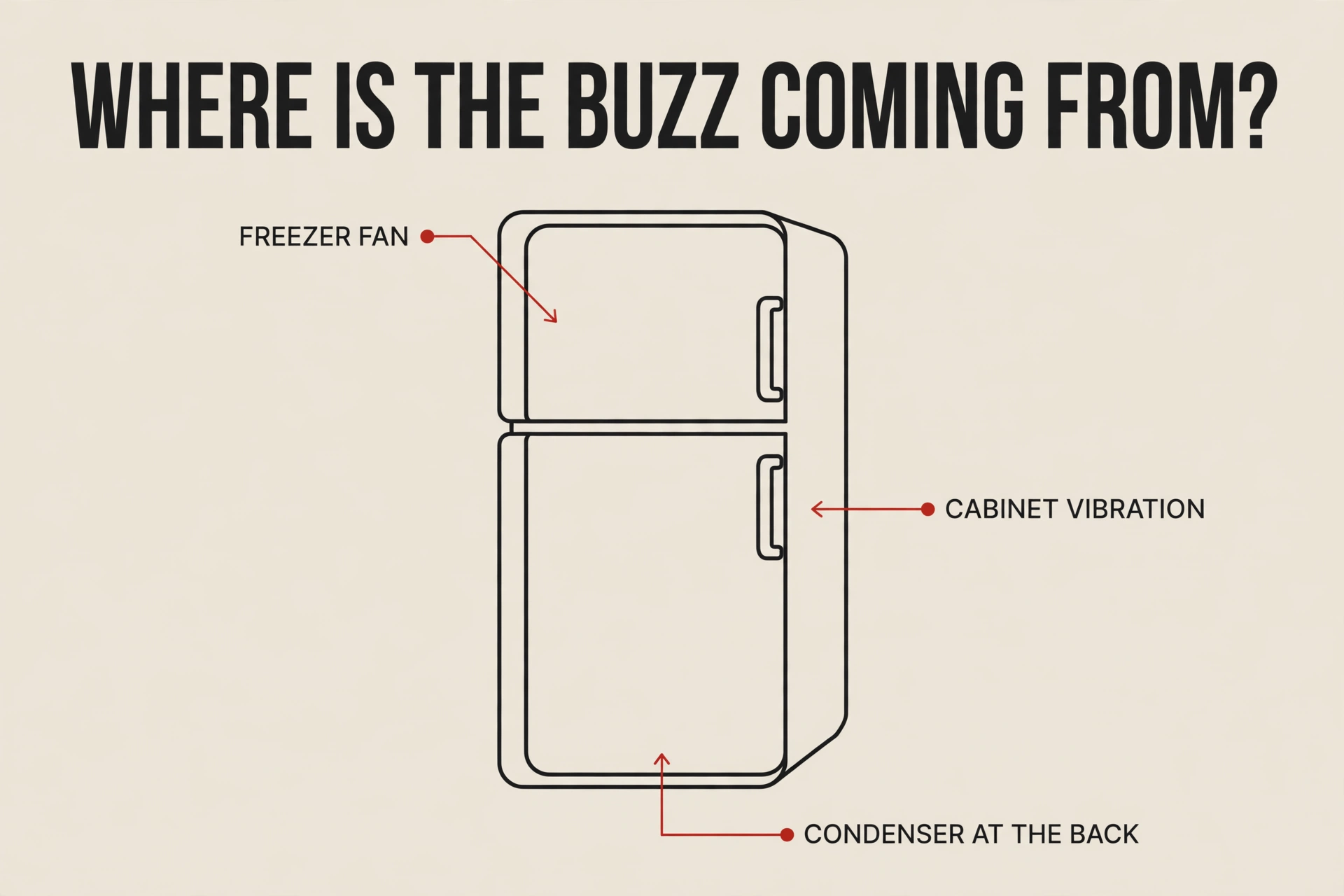
Before touching anything, stand in the kitchen next time it starts and listen. Put the noise into one of three zones — each points at a different part.
If it is loudest at the back or down near the floor, you are hearing the condenser side — the fan and coils that dump the heat. If it is loudest inside the freezer, that is the evaporator fan, the one that blows cold air around. And if the whole cabinet hums, with bottles on top joining in, it may be an ordinary hum amplified by vibration.
A buzz in the freezer and a buzz at the bottom are different problems entirely, with different fixes.
Ice around the evaporator fan
This is the most common cause of a buzz that seems to have a mind of its own. The evaporator fan sits inside the freezer, and if frost builds up around it, the blades start clipping the ice as they spin. The result is a buzzing, chirping or ticking that rises and falls, worse each day as more frost grows.
The test is simple: while it is buzzing, open the freezer door. On most models the fan stops when the door opens. If the noise stops or clearly changes, and returns when you close it, you have found your fan. A little frost after the door was left open on a humid day is normal and clears itself. If it keeps coming back, warm air is getting in — the door seal may not be closing, or the defrost cycle is failing. A heavy build-up can be cleared by switching the fridge off, moving the food into cool bags and leaving the doors open until it all melts. Never chip at ice with a knife or screwdriver — one slip can puncture a line and turn a noisy fridge into a dead one.
The condenser fan and dirty coils
Down at the back or underneath sits the condenser fan, in the dustiest corner of most kitchens. Over a year or two the coils beside it collect a felt of dust, pet hair and grease, which makes the fan work harder; loose debris can also touch the blades, producing a steady buzz or low rumble from floor level.
Unplug the fridge first. Pull it out gently; on many models a thin cover at the bottom rear is held by a few screws. Brush or vacuum the coils, pick out anything caught near the blades, and check they spin freely by hand. Make sure nothing — a stray packet, a cable, a dustpan — is leaning against the fan or compressor. Cover back on, plug in, push it home and listen that night. For a lot of people, this is where the story ends.

Vibration and levelling
Sometimes nothing inside the fridge is faulty at all. The compressor hums, the cabinet passes the hum into the floor or wall, and the building amplifies it like a speaker box — which is why it can sound worse in another room than in the kitchen, and why it often starts after the fridge has been moved for cleaning.
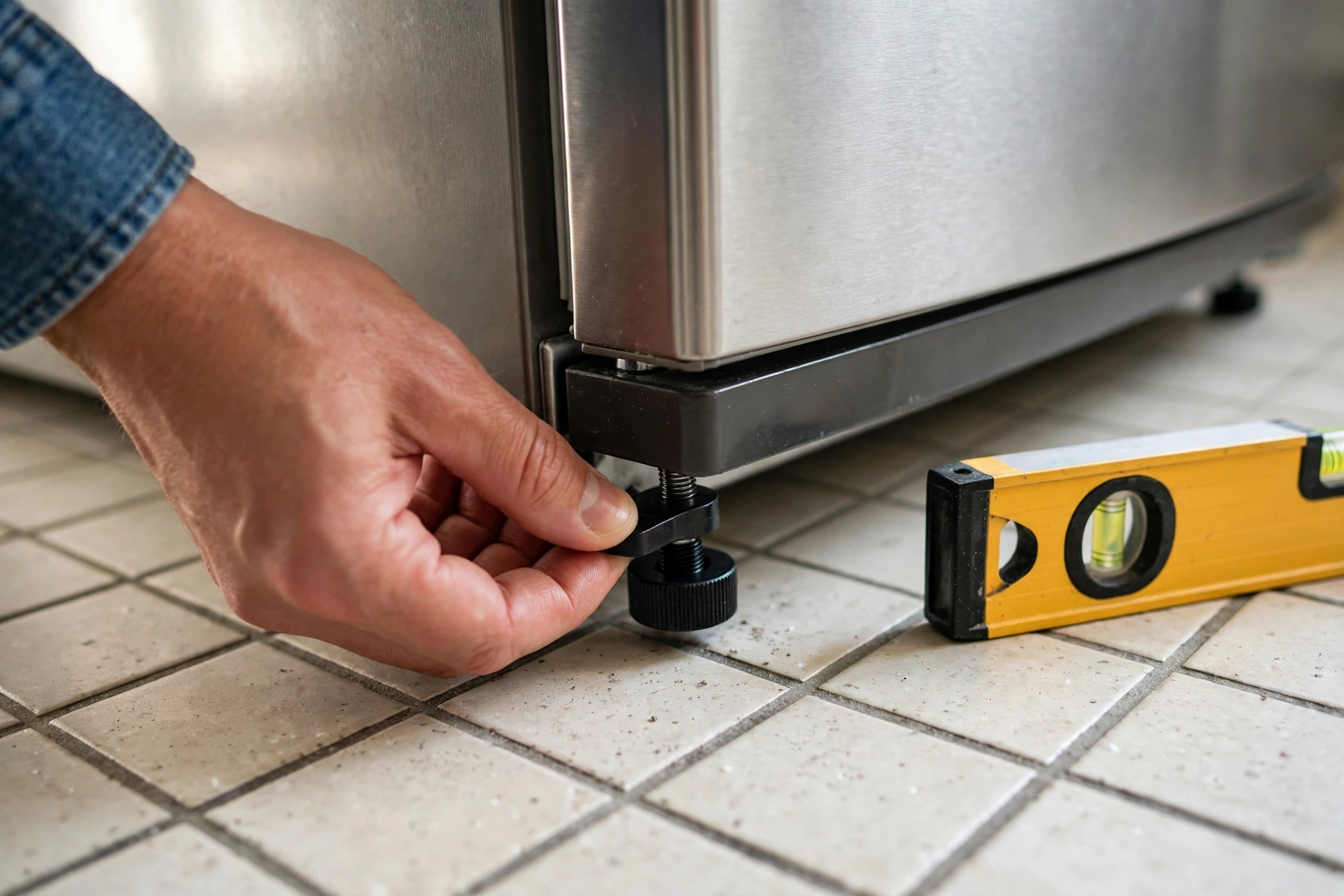
Check the simple things first. The fridge should not touch the wall or a cupboard — leave a small gap all round. Bottles on top can buzz in sympathy, and so can a loose shelf inside. Then check the feet. A fridge should sit solidly on all four corners; if you can rock it at all, one foot is doing nothing and the cabinet vibrates against the floor. Adjust the front feet — they usually screw by hand or with a wrench — until it sits level and solid. Slightly higher at the front also helps the doors swing shut. The same sitting-solid rule applies across the kitchen and laundry room — it is also step one when a washing machine starts walking across the floor.
The water inlet valve and the ice maker
If your fridge has an ice maker or water dispenser, add one more suspect. Each time the ice maker calls for water, a small electric valve at the back opens with a short buzz for the few seconds the tray fills. In a quiet house at night that can sound oddly loud, and because ice makers cycle when they feel like it, it seems random.
Short bursts that line up with the ice maker filling are normal. If it bothers you at night, switch the ice maker off overnight. A valve that buzzes for a long time, chatters, or buzzes when nothing is filling is wearing out — that one belongs on the technician list.
The compressor itself
The compressor is the heart of the fridge, and it does hum — a low, steady hum while it runs, then silence while it rests, is what a healthy fridge sounds like. Compressors can also run longer at night, when a warm kitchen finally cools and the machine catches up — or simply because nobody is opening the door.
What is not normal: a compressor that buzzes loudly while trying to start, clicks hard on and off every few minutes, or hums while the inside gets warmer. A buzz followed by a click, over and over, usually means the start relay is failing or the compressor struggling to turn over — and warming food moves it out of the wait-and-see category.
Samsung's guide to the noises a fridge makes is a useful cross-check — it sorts the same sounds into normal and call-us. A compressor that never gets a rest also never stops spending — it is one of the quiet causes in our guide to why an electricity bill is suddenly so high.
A quick guide to what you are hearing
- Steady low hum that comes and goes — the compressor running its normal cycle. Serious? No.
- Buzzing that stops when you open the freezer door — evaporator fan hitting frost. Not yet serious — clear the frost and watch the seal.
- Rattling or shaking buzz — cabinet vibrating, uneven feet, items on top. Not serious.
- Clicking on and off every few minutes — start relay or compressor struggling. Serious — see a technician soon.
- Loud buzzing and the fridge is warming up — compressor or cooling fault. Serious — call now.
When it is time to call a technician
Do the listening test, door test, clean and levelling first — free checks that fix most night-time buzzing. Call a technician if the fridge or freezer is not holding temperature, the clicking start cycle repeats for hours, the compressor buzz gets louder week by week, the fan noise returns within days of a full defrost, or you can smell anything electrical near the back. Sealed-system and electrical work is not a home job, and a fridge losing its cold is on a clock — food in a warming fridge becomes unsafe faster than most people expect.
One safety point for every check above: unplug the fridge before pulling it out, removing a panel or reaching near a fan. Fans can start without warning, and the only puncture-proof way to deal with ice is to let it melt.
Frequently asked questions
Why does my fridge only sound loud at night?
Because at night the competition disappears — traffic, television and conversation mask the hum all day. At 2 a.m. the house is quiet, sound travels further through floors and walls, and you are lying still with nothing else to listen to. The fridge usually has not changed at all.
Is a buzzing fridge dangerous?
A steady hum, a fan buzz from frost, or a vibrating cabinet is not dangerous. Treat it as a warning if the buzz comes with hard clicking, the fridge warming up, a burning smell or damage near the back — those are switch-it-off-and-call-someone signs.
Should I unplug the fridge overnight so I can sleep?
No. A fridge is built to run around the clock, and a few hours switched off is enough for the freezer to drift up to temperatures where food quietly becomes unsafe — without looking or smelling different. Fix the noise, move the vibrating bottle, or close a bedroom door instead.
How long do fridges normally run each day?
It varies with room temperature, how full the fridge is and how often the doors open, but a healthy fridge cycles on and off, resting in between. In a hot kitchen it may run most of the time. Running constantly with no rest breaks, especially alongside weak cooling, is a sign something is wrong.
The short version
A fridge that buzzes at night is rarely dying. It is a quiet house, a fan meeting frost, dusty coils, a cabinet humming against a wall, or an ice maker filling its tray. Find the zone, run the door test, clean the back, level the feet, and most nights go quiet again. If the noise arrives with warming food or hard clicking, skip the home fixes and call the technician.